
Look, we get it. It can seem intimidating to Invest in a Custom Website Design.
It can be tempting to purchase an out-of-the-box website template. They’re often inexpensive and can be set up in only a few days. But the truth is a custom website will always provide more value to your business in the long run than a template site.
That’s why it’s crucial to view your website is an investment, not an expense. In the same way that a great employee or a great store location will eventually pay dividends, the same goes for your website.
Why is that?
Here are six reasons why every business should invest in a custom website design with Fox & Lee.
The most obvious benefit to custom web design is the ability to highlight what matters most to your business. Whichever features matter most to you and your customers, you can display them front and centre.
And consider this: what matters most to you today may change tomorrow.
Any business owner understands that a business is constantly evolving. Whether it’s a new product, a new brand, or a even a new core focus, the strongest businesses are those that can pivot when the market calls for it.
A template website is confining. Even if you found a template that worked for you before, you may find yourself permanently cemented in that solution, unable to change.
Your adaptable business needs an adaptable website that can keep up with your demanding business needs and your demanding customers.
With a custom website design, you have full control and true business independence to make any custom changes required—no matter how small—to make sure that your business is never held back by your technology.
Modern marketing is all about branding. Actually, it always has been.
While your business offering may be better than your competition’s, the strength of your brand is what gets people in the door.
With a templated website, your ability to stand out from the pack will be handcuffed. When potential customers see a cookie cutter website, they see a cookie cutter business.
With a custom website design, you are far more able to showcase the true power of your brand and what makes you unique. A beautiful website design with a strong, focused brand promotes your business as more reliable, more professional, and more compelling.
A great web designer will work with you to make sure that all the best aspects of your branding are reflected in your website to make sure your visitors truly understand who you are and what you do.
Just as you should strive to give every customer a tailored, personal experience in your day-to-day business dealings, you should strive to do the same with your website.
A one-size-fits-all website solution is unlikely to give your particular customers the unique experience they deserve.
With custom web design, you can tailor your website to your customer—because you know them best.
Whether it’s a unique landing page layout, a clear navigation architecture, a highly responsive design, or an intuitive user funnel, your website needs to provide a great experience at every step of the way.
Because every interaction with your website is an interaction with your business.
Technology changes fast. It’s no different when it comes to web design.
The way people use the web is constantly changing, whether it’s newer phones, changing browsers, or other unexpected contenders entering the scene.
With a custom website design, you can stay on top of that change to ensure that your site visitors—and potential customers—are always getting the most modern possible browsing experience.
The most important search engine ranking factors can all be positively influenced by a custom website design. Especially a custom website studio that understands modern trends in SEO.
The most important ranking factor has always been the number of high-quality links pointing to your website. Nothing earns more links than a beautiful, compelling website design.
More recently, Google’s search ranking algorithm is placing more value on websites that provide an incredible user experience thanks to unique, engaging content.
Factors like the time a user spends on your site and how many pages they interact with are now taken into account when ranking your site in search results.
So the more you can “wow” your site visitors, the more likely you are to positively affect the signals that Google cares most about—boosting the number of visitors your site and therefore boosting your business.
Ultimately, you’re in business to make money. With every business decision you make, you should be asking yourself if that decision is contributing to your bottom line.
Therefore, you should treat your website the same way. Is your site simply an online business card, or is it powering your business?
When it comes to web design, a customised design is always going to generate better ROI.
Every previous benefit on this list has been building to this point. Having a custom website will draw more potential customers to your site, provide a better customer experience once they’re there, and ultimately convert more visitors into business.
That’s why it’s wise to view your website as an investment rather than an expense. A powerful website will pay itself off many times over by working for you to generate new business.
At Fox and Lee, we create beautiful solutions. Our Melbourne-based custom website design firm understands what it takes to translate a successful business into a successful website.
Ready to get started? Click here to fill out our web form now
Here at Fox and Lee, we are a proud member of our local community. When Melbourne based Businesses are looking to grow themselves with eCommerce Web Development, we are happy to lend a hand.
We offer expert design and advanced development specialities (such as CS-Cart mastery). Thus, you can trust us to transform your online presence to a strategic representation of your business.
We are committed to being apart of your online journey. We support your business as it grows online and different opportunities arise.
Here are three of the many examples of eCommerce Web Development where we developed a web solution for local businesses.
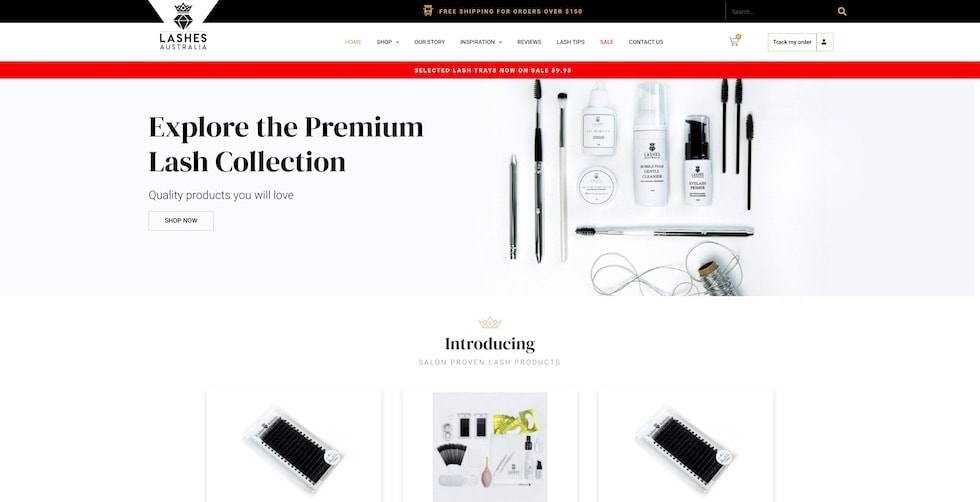
Lashes Australia is an exclusive online supplier of quality lash products. Upon visiting, you’ll notice they proudly express their core values of great customer service quality product throughout their website.
This design is bright and clean and highlights their product. Similarly, messaging is clear with key promotional details highlighted using impactful banners. Language including ‘Premium’ and ‘Quality’ reinforces their brand promise.
By including a page about ‘Lash Tips’ Lashes Australia position themselves as an expert in the industry. Additionally, they invite reviews on each product in their range. Lashes Australia is proud of its brand and products. Hence, they let that shine through with their online presence.
Lashes Australia is a wholesaler of lash extension and accessories. The transparent nature of the features included in their eCommerce web design reinforces the integrity of the brand. As a result, this speaks to their target audience, being businesses and professionals in the industry.
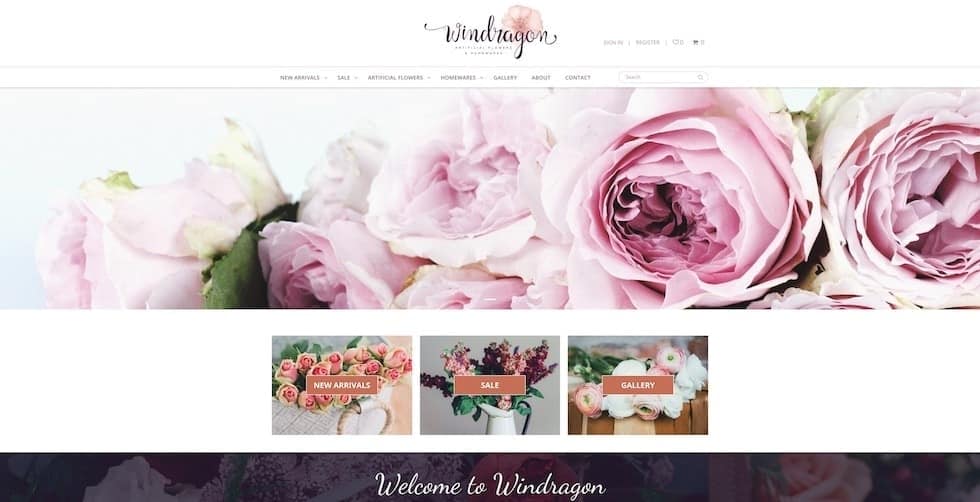
Windragon let pictures of their products do the talking on their homepage. Beautiful flowers are everywhere you look. The use of imagery acts as a strong selling tool.
Windragon’s website features an easy to navigate menu system. They’ve also included a Gallery in their web design that showcases their beautiful artificial flowers.
This website is customer-centric and makes getting in contact clear the user. The customer service provided with a user-experience focused design represents the company’s values in a digital format.
The ordering system was a key part of the development of Windragon’s website. Because of this we sorted out the backend for them and left Windragon with an easy to use web experience.
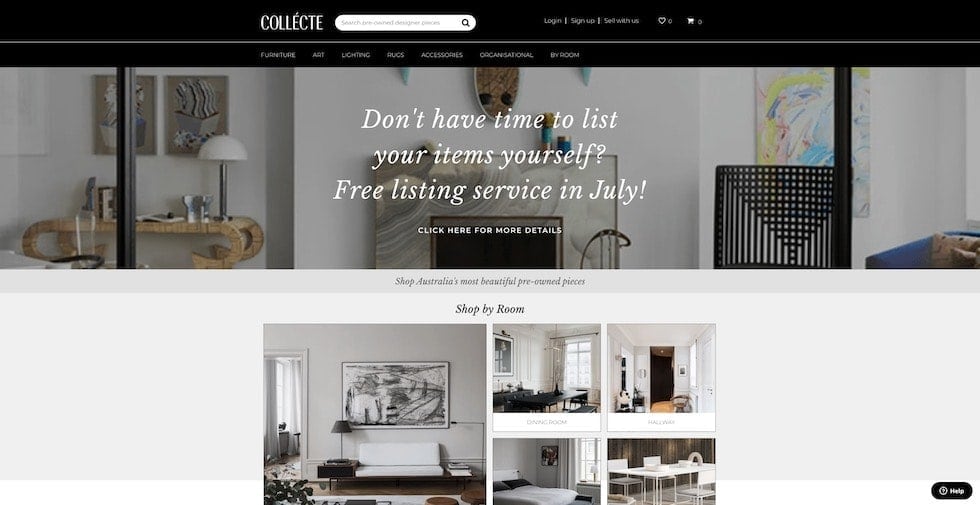
Collecte had the great idea of setting up a marketplace that focuses on preowned designer furniture.
As a Multi-Vendor eCommerce website, Collecte balances both customers and vendors landing on their homepage. Easily identifiable paths of navigation are laid out to both audiences. For example, separate help centres exist for vendors and customers in the footer of the page. Collecte manages dual requirements with specific functionality catered to each audience.
Their website’s integrity is managed through a range of features, such as a review system for vendors and an approved list of designer categories eligible for selling on the site.
Additionally, their website design incorporates a range of elements that make their website unique. Attention to detail positions Collecte to meet their customers needs no matter how varied they may be.
The best part of this website is that with all these moving parts, Collecte still feels undemanding and natural to navigate for the user.
Collecte launched this year. We’re excited to see how they grow and develop as more people discover this one of a kind website.
Here at Fox and Lee, we create Strategic Digital Solutions and Ecommerce Sites that elevate your business. We think your website deserves better than a template.
We’d love to be a part of your eCommerce Web Design website design. Please get in touch with us on 03 9043 1039 or by completing the form below.
Related Reading: 5 ways to make your ecommerce solutions more profitable
Online Shopping is very popular at the moment. Consumers needs have changed and a lot of businesses have had to change the way they do things to survive through the COVID-19 Outbreak. We’re hearing a lot of questions about whether online shopping will continue at the same pace after local lockdowns end and the pandemic is resolved.
We’ve looked at Google Trends and compared some keywords to see what consumers have been looking for over the last 12 months. This helps to show us how people were shopping before and what’s happening now.
Understanding the demand for online shopping can help when considering a custom ecommerce website for reaching new customers.
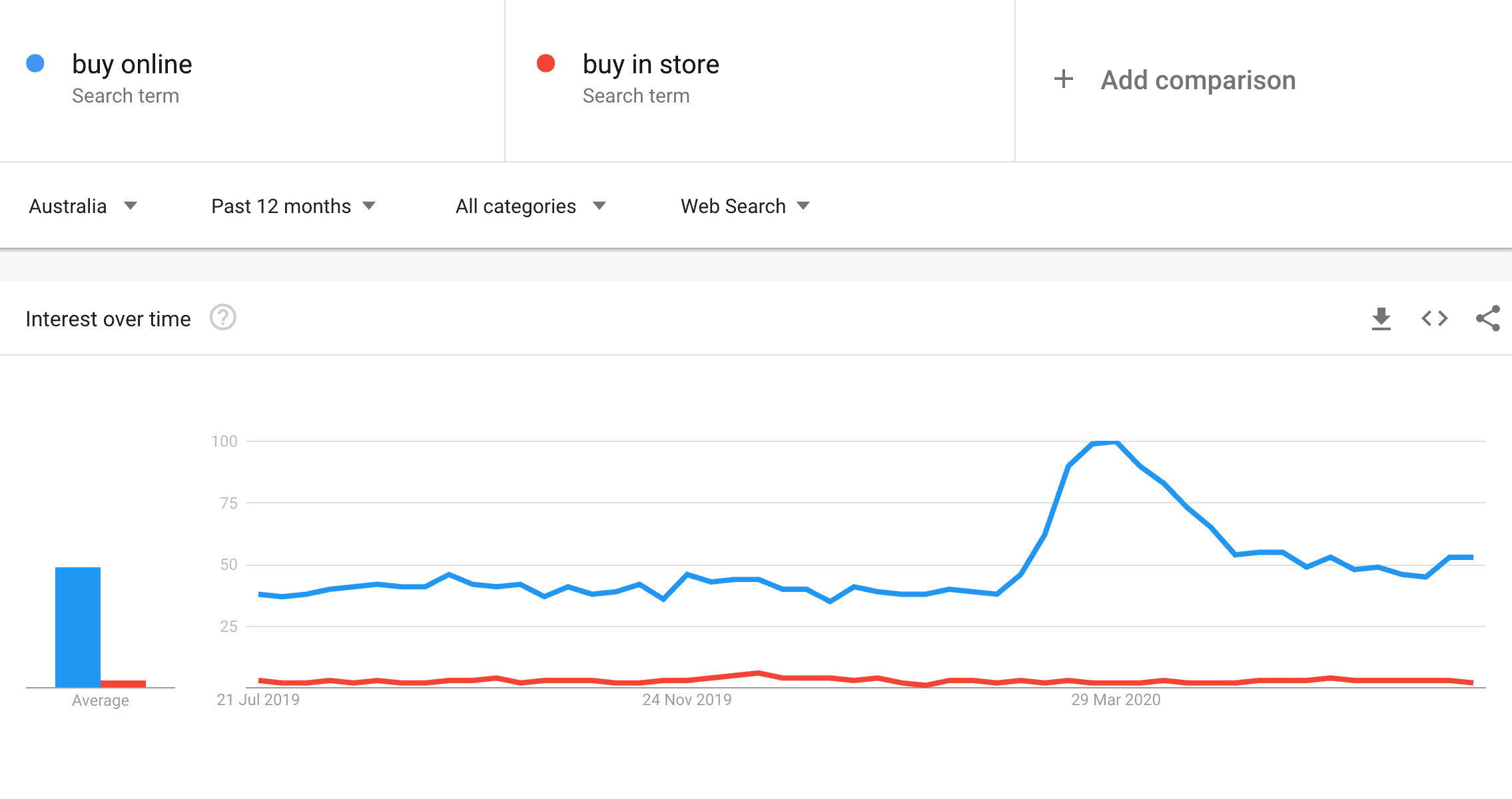
The trend is really easy to read here. For ‘buy online’ you can see that after the peak brought on by the first wave of restrictions that search traffic has still maintained at a higher level than where it previously sat.
Across Australia people have been looking for things to ‘buy online’ more than ‘buy in store’ consistently over the last 12 months.

A very similar trend on this comparison. Omnichannel retailing has become increasingly more popular in recent years. While both ‘delivery’ and ‘click and collect’ involve visiting a website, delivery allows customers to not have to leave their home. So unsurprisingly delivery has been incredibly popular through the COVID-19 Outbreak.
As with the pervious example, a years worth of data shows that customers have been happily engaging independently with a company’s website for some time now. The interest in delivery seems to be still growing. It’s an opportunity for your store to reach customers wherever they exist.

Search traffic for customers looking for an ‘online sale’ has peaked and dropped over the last 12 months before positively settling in recent months. A small peak of interest for ‘in store’ sales can be seen at Christmas. Comparing this to the traffic for ‘online sale’ seems unfair but it’s relevant.
People looking for sales in stores are seasonal, but the data shows people are nearly always looking for sales online. We think this is a huge indicator for why online shopping will continue at a similar rate after lockdowns are lifted.
The COVID-19 Outbreak can be very stressful for those managing a business. You may be conflicted about whether it is a good time to adapt your business model and expand your digital presence.
Your customers are online, and they aren’t going anywhere, anytime soon.
With all the support available to Victorian businesses it is a great time to invest in an innovative online shopping experience to engage more customers.
Once you’re ready to get started you can contact with us on 03 9043 1039. Alternatively you can fill in the contact form below. We’d love nothing more than to play a small part in helping your business grow online.
"*" indicates required fields
We know from Google Trend analysis that online shopping isn’t going anywhere and it’s more important than ever to be thinking about your online presence. Maybe this is something you’ve been thinking about for a while, but the cost to build a website can be intimidating. Your business and your brand are important, so the investment of time and money in a good quality website should be a key element in your COVID-19 recovery strategy.
The digital experience you give your customer should be at the same level of great service you give your customers face to face.
We’ve done some research to list where you can find different Government grants and programs that could potentially contribute to your budget. Hopefully this can help bring the dream of a beautiful new website a little bit closer to a reality.
As an example, for us here in Niddrie the City of Moonee Valley the local government is offering $10,000 grants for Adapting to Changing Needs.
This includes online innovation, web design and redevelopment, ecommerce platforms, mobile app development. We’re currently working with local businesses who are applying for these grants and taking the opportunity to discover new customers waiting online.
The Victorian Chamber of Commerce has put together an Employer Guide for COVID 19. It is regularly updated and includes changes to the Modern Award. That’s something every Victorian business owner should want to be aware of.
While you won’t get a cash injection reading this guide, it helps prevent legal costs or fines that could take away from any budget you’ve put aside to cover your costs for building a website.
GrantConnect is a portal where you can review a variety of different grants. They come from different states, industries and programs. Each grant covers useful details such as categories, close dates and eligibility criteria.
This is a great place to find any niche grant opportunities you many not have been aware of specific to your industry.
When Victoria went to Stage 3 Restrictions again on the 8th of July the Business Support Fund was extended. What does this mean for you? If you’re already getting JobKeeper there is now another $5,000 grant available you can currently apply for.
One suggested use of this grant is “developing the business through marketing and communications activities”. We can’t think of a better way to achieve this than updating your website to generate new customers.
Leave no stone unturned. The grants and programs portal at Business.gov.au asks you a few questions and then generates a list of grants specific to your business.
While this list is shorter than the one at GrantConnect it is another place to regularly check for resources that may be available to you.
Depending on eligibility grants might not be an option for you. We know the investment of a strategic and stunning web presence will play a key role in how you operate post the COVID-19 outbreak.
That’s why we’ve included the Coronavirus SME Guarantee Scheme. This scheme gives you an opportunity to get an unsecured personal loan that includes an initial 6 month repayment holiday.
Victorian businesses are eligible for various tax relief measures as a result of COVID-19. If you haven’t already lodged your tax for the last year it’s worth reading up on.
You can use your tax return as an opportunity bring in some extra cash. Any extra budget could be put towards the cost of building your website.
We hope you found this list helpful, but we aren’t experts in government stimulus. We’re experts in custom web design. Eligibility criteria, close dates and other relevant information can be found on the linked websites. It’s worth looking into and seeing if there is anything you’re not currently getting that you’re entitled to.
If improving your online services is part of your COVID-19 Recovery Strategy we can help with stunning bespoke web design, development or custom ecommerce solutions.
Once you’re ready to get started you can contact with us on 03 9043 1039. Alternatively you can fill in the contact form below. We’d love to be a part of making your website a beautiful reflection of your business.
Are you looking for custom web development for your ecommerce store? Then you’ve probably been wondering if you should choose a template or invest in a custom web design. The debate has been going on for years, and even though both have their advantages, we’d like to point out why we would always opt for custom designs for online stores.
We know it’s more expensive and that’s probably reason number one for people to choose templates instead. But the benefits of a custom web design are significant compared to the cost of it. We’ll run you through the most important benefits of custom website development for ecommerce – so you can make up your mind yourself!
First of all, custom web designs give you the option to fully personalise your webshop. While templates let you pick your colours and insert your own logo, you won’t be able to match your website exactly with the brand image you so carefully worked out.
A custom web design lets you decide on every pixel that goes on your website. You can tweak your fonts, colours, product images, tone of voice, filters, grids and menus until it is a perfect reflection of your business.
Also important is that it will give you the possibility to differentiate yourself from your competitors. And with so many ecommerce stores available these days, it is important to do things differently.
Since you can only slightly adapt a template, you might end up with a website that looks more or less the same than any of these other ecommerce websites. Customizing your website will give you the opportunity to stand out from the crowd and attract new customers.
If you want to rank well in the search engine results, we would recommend investing in a custom design. Since it’s built from scratch, you can literally adapt every piece and bit to fit into your SEO strategy.
We know, templates have a couple of SEO tools available, like the option to add alt-tags or keywords. But you can’t change much about the coding that’s used behind the scenes.
Custom ecommerce stores give you unparalleled control over your SEO. This also means that you can quickly adapt when an algorithm update rolls out or if you see any other drops or changes in your traffic.
A custom website design is specially made for your ecommerce business. This means it’s fully adaptable to the unique requirements of your shop. You can decide how many pages, how you want to display your products, what filters and features you want to implement and what social channels you want to connect.
And even better, if your business grows, your website grows with it. Since the ecommerce store is made for your unique products it will be easier to implement new functionalities and products when you expand. A custom web design means you won’t have to upgrade your website in a couple of years, but it will stand the test of time.

And lastly, a custom design is not only beneficial for your store but also for your customers. Since you can decide how every part of your website is going to look like, it’s easier to keep your target audience in mind.
This customer-centric approach lets you really follow the customer journey of your potential customers. You can reach them with the right messages and optimise conversion paths to get drive more sales.
Want to hire an ecommerce web developer? Here are some tips.
Web development is complicated in any project. Especially so for ecommerce web development. You have to consider different aspects such as web design, usability and performance in order for your website to look and function well. The development of your custom website is, however, the backbone of all your further operational and marketing efforts. Think for example of how a good web development leads to better SEO results, how a functional website increases a good user experience or how different content management systems can make your daily life easier.
So there’s no doubt that you should put some thought into the development of your company’s website. Especially when it comes to ecommerce web development, there are various other factors that will only make the web development process trickier. A complex website, like an online shop, will not only offer challenges when it comes to the structure of the website or its design but also regarding your stock inventory and payment processes.
We know there’s a lot involved when we talk about ecommerce web development. It often gets technical and the developer’s jargon might leave you with your head whirling. We would like to help you understand the basics of web development when it comes to ecommerce. That’s why we created this handy guide that focuses on different aspects of the process, so you know what to look out for. We will talk you through the development processes of ecommerce stores and what you should be focusing on in 2019.
Let’s start easy. E-commerce refers to buying and selling goods using the internet. We probably don’t have to tell you how popular online shopping became the recent years, but we’d still like to show you this graph – just in case.
With more and more people buying online, it shouldn’t come as a surprise that there are millions of ecommerce websites online for people to choose from. Differentiating yourself from your competitors becomes increasingly important and this all starts with having a strong and well-developed online webshop.
There are different types of ecommerce models, such as B2B or B2C, and different types of stores (think of drop shipping, wholesale, retail etc.) But one thing all these stores have in common is that they’re unmanned, meaning nobody helps you browse through the products or sits at the counter to complete your transactions.
Since there are no physical employees present in the store, your ecommerce website should focus on all these tasks. And with your website taking over, you need a website you can trust. Let’s have a look at the web development process of ecommerce stores and the different aspects that come with it.
So you have an idea, you have your products (whether or not you have a physical stock), and now you need a platform to sell your goods on. A custom webshop is most likely what you’re thinking of – although alternatives could include selling your products on Amazon or Ebay. But for the sake of this guide, we’re going to build a custom webshop, where you can show your products in all their glory.
Let’s look at the basic things we would need in order to build an online store:
This is a non-exhaustive list of things to consider when you start building a webshop. Luckily, there are many platforms these days that offer you an easy approach to all the technical stuff. Those platforms allow you to upload your products, keep track of your stock and with some easy drag-and-drop work you can design your pages. They connect your CRM and even send out automated emails.
And don’t get us wrong, we love these platforms. Even better, we use them ourselves (we’ll tell you which one later on). But it’s important to consider the limitations too. However they are very easy to use, there are still a lot of functionalities that will require more advanced knowledge of web development. And by just using an off-the-shelf web solution, you might not be so different from your competitor. An ecommerce web developer, however, will know all the integrations and functionalities you need to not only build a custom website that exactly fits your brand, but they will also help you increase your sales funnel conversion rate.
So we mentioned it already: we are not going to reinvent the wheel. There are brilliant platforms on the market that offer a great tool to build an ecommerce website, so we would be stupid not to make use of it. Our preference goes to WooCommerce, the WordPress plugin that is specialised in ecommerce.
We don’t want to claim it’s the best platform, but it fits our needs best. It gives us a lot of options and freedom to create the exact products we want and it has proven to be successful. We’ll give you a couple of reasons why we love WooCommerce, but feel free to do your research and make up your own mind!
WooCommerce is a WordPress plugin that adds ecommerce functionality to your WordPress website. It’s easy to install and set-up and can be integrated with your WordPress theme. It gives you full control over all your data, which means it’s reliable – even if something would go wrong with the platform itself.
WooCommerce also offers you complete control over your products. You can decide on product types, quantity and variations yourself. And with its inventory management system, you can take full control over stock, back orders and product management. When it comes to payments, WooCommerce has fully customisable check-out processes and payment gateways that you can choose from.
Furthermore, WooCommerce has a lot of extensions, plugins and integrations available, so you can customise your shop entirely to fit with your own ecommerce brand. That’s enough for us to make it our go-to platform for building beautiful and functional webshops – and it’s the reason we’ll focus on WooCommerce in the rest of this guide if we want to get a bit more specific when it comes to certain features.
When developing an ecommerce website, your product catalogue will be at the heart of many decisions. That’s why we need to ask ourselves a couple of questions regarding our products. For starters, you should look at the products you are going to sell. This varies a lot depending on the type of store and your business model. You might be selling your own creations, which means you are limited to what you have, or you might be selling your goods from a wholesaler.
In the last case, you should think about your niche and potential customers, and see what product variants or related products they would benefit from so you can extend your product range. Same goes for different types, colours or sizes, where you need to make decisions to see what you’re going to offer and what not.
You should also think about your stock inventory. Are you going to buy the products and store them at a location or do you work with dropshipping delivery? You might want to set up an affiliate ecommerce store, where you don’t actually need any products at all. Your stock is normally controlled by a system that will notify you when you’re running low. But it’s up to you to make decisions if you want to offer it again and to figure out how long it will take for the product to be delivered.
So we have our product catalogue and we have our platform. Let’s have a look now at how we can blow life into this online shop. And the best way to start is by organising things. Your information architecture is an important step for the user experience (UX) on your website and it will give you a lot of direction when developing your site.
So what does this entail? You’re basically going to collect all the information that you want to include in your ecommerce store, and then categorise it into different groups. By doing this, you will get a clear overview of how you can divide the pages, what information goes on these pages and what product categories you will have. Not only your product catalogue will benefit from this, but it will also help you when creating navigation menus and deciding upon URLs.
Let’s clarify things with an example. Let’s say you want to sell sports equipment online. You could decide to categorise your products by sport, for example, creating categories like rugby, tennis and basketball. A second division would be to split the categories in equipment (like balls, nets etc.) and clothing (which can be split into male and female). These categories will probably be present in your menu, giving users the chance to quickly find what they’re looking for. It will also help your users when they’re using the search function on your website, looking for tennis balls for example. And finally, a good website structure with URLs like mystore.com.au/tennis/clothing/female will get you better SEO results.
In addition to your different product categories, you should also decide on other information you want to include on your webshop. Maybe you want to write educational blog posts about sports, that you can put under a blog section with different categories. You might want to include a page about your shipping & return policy, or maybe you need some extra space to include details about your products. Don’t forget to think about standard pages like an ‘About Us’ page for your brand story and a contact page for customers to get in touch.
Once you have the main layout of how you’re going to categorise your products and ideas, it’s time to look at the pages itself. You can decide what type of information you’d like to include on the home page, what details are needed for the different products, where your logo goes and where you add your crucial business information. Of course, you don’t need to know every exact detail (leave some work for the designers) – but it helps a lot to start with a good organisation of your information.
By now it should be clear how much information or content your website will contain. And to display, create, publish and maintain all that content you need a good Content Management System (CMS). A CMS is a tool that you will use to enter and maintain all your data and files, that is easily accessible without having to go into the website’s code. An example of a CMS system is WordPress.
A big advantage of a CMS system is that is separated from your design. This means you can enter text, place an image or update a price in the CMS and it will appear on your website in the right style. This gives you a basic framework where you can modify each element of your website, without having to worry about more technical issues. Another plus is that a CMS helps with your SEO, where all the right tags are automatically applied and you have the option to enter meta tags and alt tags in the CMS directly.
In the case of an ecommerce store, your main type of content will most likely be your products for sale. With the WooCommerce plugin, you have a CMS that gives you the option to enter all the product details, such as attributes or its status.
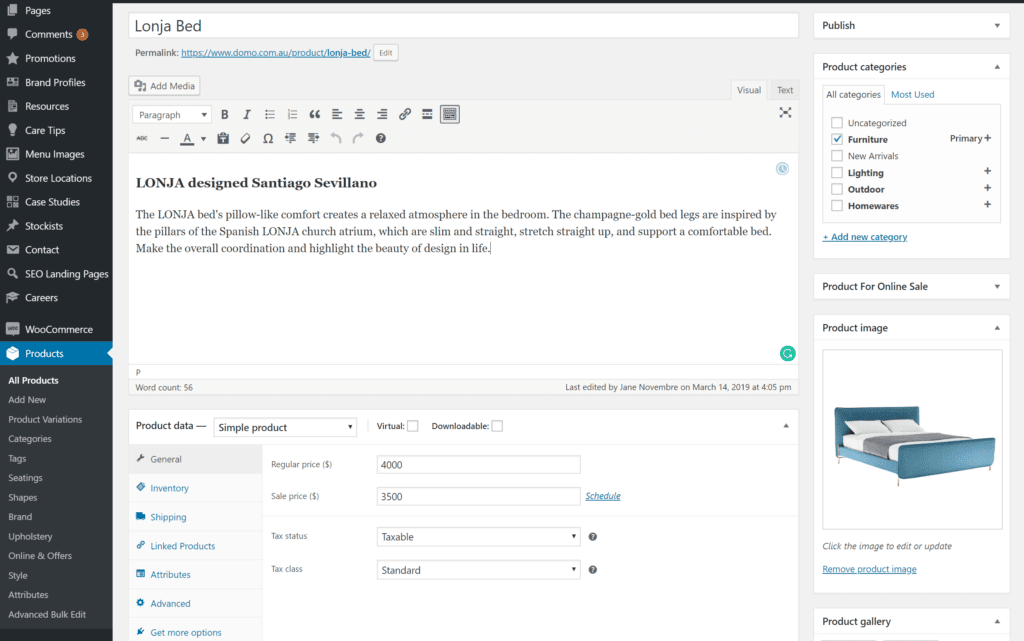
WooCommerce CMS
Having all this information in your CMS will not only give you a handy overview of everything but will also ensure that the information is organised on your website. Depending on your theme or stylesheet, the website will pull this information out of the CMS in order to display this in an orderly way to your customer. In addition, you can create product categories and subcategories based on what you attributed in the CMS.
A CMS is what you use ‘behind the scenes’ to organise the products and content on your website. But from the user’s perspective too, it can be challenging to find your way through the complexity of an online store. That’s why we have to ensure product filters and attributes that will help us categorise everything – on both ends.
Product filters are an essential part of improving a customer’s experience in your store. It will give them the option to quickly refine a large product range to find exactly what they’re looking for. Filtering the products also gives them the option to manipulate the content, increasing the personal experience they will have.
So what filters should you include on your ecommerce store? The answer to this highly depends on the products that you’re offering. Examples of filters that are available in most ecommerce stores are the price range and the brand, but when you think of clothing, for example, you’ll quickly associate filters as size, colour and fit.
Like we already mentioned, these filter categories are established as attributes in the CMS. It’s here that you enter the size and the colour, and that data is used to pull up the right results when somebody filters your products. But how do these filters function on your website itself? Filters usually appear on the left-hand side of your product page and can be displayed as checkboxes, links or tabs. Users normally get the option to select various options, and sometimes they’ll see little tags of the applied filters on the top of their screen.

Product filters in online clothing store Cotton On
In addition to filters, most online stores also offer a search function in their webshop, allowing users to quickly find the right product. The ecommerce site search is usually a search box that is big enough for typical queries, found on top of the website’s page. Since users using the site search are more likely to convert (searching for a specific terms means they’re already further in the buying cycle), it’s important to install a well-working site search on your ecommerce site.
Our webshop is taking more shape now we’ve included our products, content and filters. Now, it’s time to connect everything through internal links. Internal links are not only important for your SEO (more on this later) but are also necessary to keep your visitors on your website. It gives users the possibility to browse through your website and go from one page to another, which will ideally lead to conversions.
The most important internal linking structure is set up when we decide on our site structure and create our navigation menus. By doing this, we organise our content into categories that are more or less important and we tuck our subcategories away underneath the bigger ones. By doing this you will make your more important categories better approachable to your users and you will show the Google bots which pages have more relevance.
In addition to your site structure, it’s also important to include internal links between other pages on your website. Links can go from one product page to another, from a subcategory to a blog post or from a blog post to a contact form. Linking from one product page to another is mostly done by features as ‘Related products’, which will send your customers to other items they might be interested in. Linking to a blog post is something you can do when you write a tutorial or an educational article on one of your products or categories.
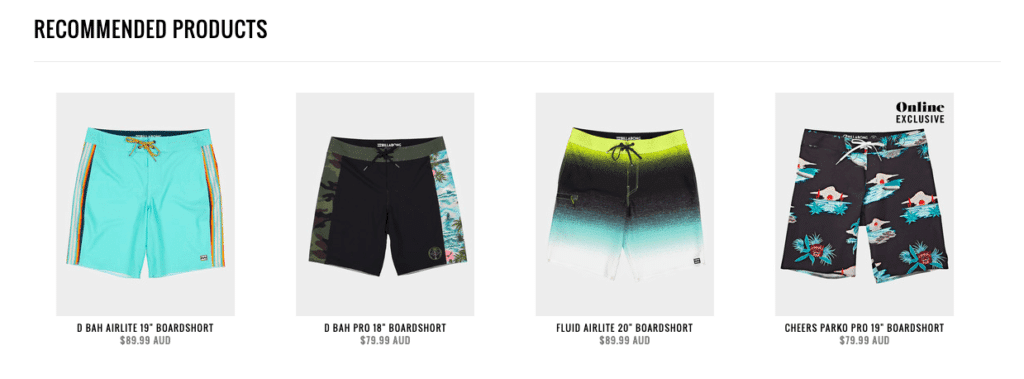
Recommended products show up under the product you’re viewing in the Billabong shop
When you think about an internal linking strategy for your ecommerce business it’s important to keep in mind that you’re creating the internal links in the first place for your customers. Keep the links natural and relevant and don’t try to focus on SEO only.
Now we’ve reached the topic of SEO, it’s time to zoom in on our website optimisation for the search engines. Since we cover most of the on-page and off-page in our complete SEO guide, we will only talk about SEO aspects that are important for ecommerce web development.
We talked about ecommerce structures and internal linking, but it’s important for your SEO that you provide a complete inventory of your website so the bots can crawl it easily. By creating a sitemap you will help them find your pages and you can upload this in the Google Search Console. Furthermore, it’s also necessary that this structure is reflected in the URL – displaying your categories and subcategories clearly.
Another important aspect of SEO is the optimisation of your tags, so it’s important to verify your title and heading tags. E-commerce stores usually work with a template for their meta tags with a pattern that is easily recognisable in the search results. By using shortcodes that automatically pull up the category names you can avoid having to go through all your product pages and insert meta titles manually.
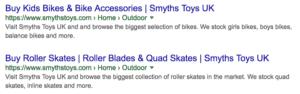
Source: Ahrefs
Great for your SEO is also Schema Markup. It will help customers click on your result compared to your competitors because it provides them with more relevant information.
What would you rather click on?
This?

Or this?

There are a lot of properties to add to the schema property but here are the ones you should add to the product pages.
Last but not least, we should focus on technical SEO issues when developing an ecommerce website. Think about avoiding duplicate content (and thus not having two identical pages on your website) and keyword cannibalization errors where you let multiple pages rank for the same keywords, so they compete with each other.
In addition to the basic features WooCommerce offers, there are probably a lot of integrations you would like to consider in order to adapt your online store to your exact needs. We’ll go over a couple of integrations you can’t miss for your ecommerce store, and we’ll start with social media.
We know it’s all happening on social media, so don’t forget the importance of these channels for your ecommerce store too. Focusing on social media will be one of the best ways for you to attract new customers, but we’ll talk about ecommerce and social media marketing later on.
At this point, we want to point out the things you should include in your ecommerce web development in order for your social media and website to be integrated. Of course, it’s important to provide a link from your store to your social media pages, and this is usually done by including the social media icons in the footer of your website.

There are however a couple of other ways for integrating your online store with your social media channels.
A first thing you want to include on your website is social sharing buttons. These buttons give customers the chance to share a page or product of your website with their followers. Modern customers have stronger relationships with the brand they support and will be more inclined to share their opinion with the world.
Including social buttons is best done on the separate product pages, so your customers can easily share their favourite items. It’s important to adapt the social sharing buttons to fit on your page without interrupting with the buying process, and we would recommend creating new icons that differ from the ones you used on your home page. Also, think about what channels you connect here. When it comes to online shopping, Facebook and Pinterest would probably be interesting, LinkedIn is probably better to leave out.
A second connection with social media should be made through social sign-ins. When a customer wants to buy something on your website, they will have to create an account in order to keep track of their purchasing history, saved items and shipping updates. But instead of having them to fill out a lengthy form, you can offer them the option to sign in through one of the social media channels they’re already active on.
But there’s more. In order to attract more customers through your social media, you can integrate your entire online store with Facebook. WooCommerce has a handy plugin that will connect the two, but let’s see what this can be used for.
First of all, there’s your Facebook store, where your products can be viewed on Facebook. Your products will be automatically imported into your Facebook store, with details such as prices and images included. Customers will either be able to buy it on Facebook or they have to click through to your website to complete the check-out process.
Once you have your products in your Facebook store, you can tag products in your Facebook posts. Customers will then see the products shown in your picture or video and immediately see all the details. Integrating your Facebook store with your WooCommerce store will furthermore give you the option to create Dynamic Product Ads on Facebook or retargeting ads to people who’ve visited a certain page or viewed a certain item on your shop.
There’s also an Instagram integration possible for your online store. Similar to Facebook, you can upload your products into your social media store which gives you the option to tag the products you’re showing on your Instagram posts. Customers can then just click on the item in order to purchase it in your store.
Another integration you can’t skip is connecting your online store with an email service. Emails will be an important part of your selling process, whether it’s to send an order confirmation, shipping updates, abandoned shopping cart reminders or newsletters.
A first step is to choose an email marketing platform. Examples of good email platforms include Mailchimp, Mailster or OptinMonster. Within your email marketing platform, you can create the emails you want to send out when certain actions are taken on your website. The tools often give you the option to do this entirely in your house style so you can include important branding elements.
By connecting your email platform and your ecommerce store, you can make sure that emails will automatically be sent when triggered by a certain action. Examples are completing a purchase, sending a reminder or just sending a welcome email when they sign up for your mailing list.
Unless you’re planning not to make any money with your store, a payment gateway integration is a necessary thing to include in your webshop. A payment gateway is an ecommerce service that processes credit card payments where key information is being transferred between your payment portals. Since there’s money involved, this should, be safe and encrypted information – so your customers can safely spend their money.
Examples of safe payment gateway integrations are PayPal, Square and Stripe (they accept master cards and visa cards). When deciding upon the right integrations for your store you should look at the processing speed, user-friendliness and transactional fees that might be included (especially when dealing with international customers).
When you have an established ecommerce store, you want to know how it’s performing. That’s why you need to connect your online shop with an analytics tool, so you can keep track of what’s working and what’s not.
Having all the important data available will give you a good idea of how your website is performing, where your customers are coming from and how they’re behaving on your website. There are various tools available that will all give you different insights regarding the demographics of your customers or their user interaction with your website. Here’s a list of some top tools we’d recommend:
Once you’ve sold an item on your website, you should make sure it gets to your customer. When you just launched an ecommerce store, chances are high you will be taking care of the shipping process yourself. This means you have to process the order yourself, pack it, label it and send it.
Once you’ve been able to grow your business, you might want to consider automating this process. There are various integrations possible for your ecommerce store. Examples include Transdirect, Australia Post Shipping Method or TNT Express plugin. By using one of these tools, the work of calculating shipping costs and adding additional costs will be taken over by the integration.
If you work with a drop shipping delivery method, the shipping process will, of course, be different. When you work with WooCommerce Dropshipping, the order confirmation will be sent automatically to your wholesaler. Your partner will then take care of the actual shipping. Of course, giving this process out of hand also means there’s more room for mistakes. Make sure your integrations work seamlessly in order to avoid customers’ complaints.
When you’re selling products online, you’re going to have to find new ways to engage your customers. A good way of doing this is by offering promotions and discounts on your online goods. Promotions and discounts can happen in many ways:
Whatever discount you decide to offer, your webshop should be able to process this. You should either show the discounted rate on your product page or have the option for customers to apply a discount code in the check-out process, without it being a big hassle for you. A lot of discount tools and integrations will help you to make this process a lot easier.
One last thing we want to discuss when it comes to ecommerce web development is the expansion of your website. No matter what ecommerce platform you decided to go with, what your design is or how many integrations you connected – you always need to keep an eye on your future expansion plans.
The most important aspect of your ecommerce store that should be scalable is your database. Your database contains all the data of your products and customers and should thus be able to grow with your business. This means the structure of your database should be able to handle the load, whether that structure is cloud-based or spread out over several servers. In addition, enabling indexing and intelligent caching can help handle high-frequency transactions.

We’ve covered some of the main aspects you want to think about when dealing with ecommerce web development. But a successful ecommerce store doesn’t just depend on strong web development. In this last chapter, we’d like to shine a light on some other aspects that come into the picture when you’re launching your first ecommerce business.
A web host is a business that provides the service and technologies needed for a website to be viewed online. Your hosting is a virtual space where you save all the data and files that are on your website. Important with website hosting is that it allows you to have a fast website that is secure and that they offer the necessary support.
The hosting of an ecommerce website isn’t much different than other websites, but there are a couple of things you should keep in mind when deciding on your hosting platform. First of all, you might be dealing with a lot of data. Extensive product catalogues with high-quality pictures should be saved on a hosting platform that can handle this amount without it getting slowed down. Secondly, you need to consider how much traffic you’ll get and if your hosting server will be able to deal with this. You wouldn’t be the first website to crash after a TV commercial sends thousands of new visitors to the website all at once.
Another thing to consider is its safety and security features. Do they offer Secure Sockets Layer (SSL) certificates or do they have a backup functionality in place so your data won’t get lost? One last thing to keep in mind is their support service for if something goes wrong. Is there 24/7 assistance available?
We only talked about the web development of an ecommerce store until now. However, you will also need a store that looks pretty and functions well. That’s where your web design comes in. Your web design should focus on a user-friendly design, that organises the information in ways that are easy to navigate for your users.
Web design is necessary when you get all the information out of the CMS, in order to give it shape on your actual pages. This means you’ll be defining the size of the images, the colours of the buttons, the number of columns you’ll use to display your products etc. These little details might only seem important for the aesthetic aspect of your website, but they can actually enhance the user experience if done well.
The User Experience (UX) in ecommerce plays a vital role. Simple and clear interaction components, attractive product presentation, easy check-out processes and effective use of visual elements can all influence the profits you’re making with your ecommerce store.
In the case of ecommerce there are four key aspects of UX that are quite clear:
Applying the principles of good UX to your website is necessary if you want to offer your users a good experience. We wrote a whole guide about UX with tips on how to improve your website.
So you build a beautiful shop online, but without marketing, you might as well have set up a store in the middle of the woods somewhere. You need people to find your store and that’s where a good marketing strategy comes in.
There are many aspects of your ecommerce marketing. First of all, your SEO should be on point so you can improve your rankings in the search results. But next to your search engine marketing, you should also consider other channels to reach your customers.
Social media, for example, is an important medium for your marketing. Platforms such as Facebook and Instagram give you the chance to build personal relationships with your customers. They are the ideal channel to focus on both the promotional aspect and your brand image.
Also, email marketing isn’t dead. Sending out newsletters with product updates, new collections or sales will bring your brand to the top of your audience’s mind. Emails are also a great way of getting more engagement since call-to-action buttons usually send your users straight to your landing pages.
Finally, there’s paid advertisement which can be done on either social media or Google. Google Adwords will give you the option to place ads in the search results. With search ads, you can reach people that are already searching for products like yours and thus more likely to convert. Display ads and YouTube ads, on the other hand, are a perfect way to introduce your brand to new customers. Retargeting ads are the best way to find people who’ve already been to your website but need a little reminder. Google Shopping ads are key for businesses that want their products to show up within the first results.
On Facebook, you can choose between different types of campaigns. These can be focused on either increasing brand awareness, getting new page likes or attracting new visitors to your website. Especially interesting for ecommerce stores are the conversion-focused campaigns because they focus on driving you sales.
Setting up an ecommerce store involves a lot more than just the development of a website. By hiring a full-service agency, you are sure you have a full team behind your business, that can help you with tasks ranging from hosting a website to branding your store. Don’t miss out on any customers because of bad UX or the lack of a marketing strategy, but get an expert to help you out!
Talk to us about your ecommerce adventure and we’ll be happy to show you how we can help.
There are a lot of platforms available for the development of your ecommerce store. Examples include Shopify, Magento, WooCommerce and BigCommerce. All of these online-shop builders have their own advantages and disadvantages. Here at Fox and Lee, we refuse to use anything else than WooCommerce – and trust us, we have our reasons. We’re happy to share the benefits of WooCommerce compared to other platforms with you.
Let’s start with a quick reminder. WooCommerce is the free WordPress plugin that adds ecommerce functionality to your website. Even though it’s ‘just another WordPress plugin’, it’s unbeatable in its functionalities and potential. The more than 4 million active installations speak for itself. WooCommerce integrates seamlessly with WordPress and gives you access to hundreds of free and premium extensions.
Now, what are the benefits of WooCommerce?
First of all, WooCommerce is a highly flexible product. It offers you a lot of options when it comes to your products, where you can tailor your own product categories and attributes so you can build a shop that exactly fits your brand. You can sell whatever product you’d like, whether these are physical objects, appointments or downloadable files.
WooCommerce also has the great benefit of being not just an ecommerce platform. Since it integrates with WordPress, you have the opportunity to integrate your shop with a professional custom website or even include a blog for your SEO and content strategy. Because it’s all accessible within the same interface, it’s easy for you to make adjustments while still keeping your brand identity intact.
One of our favourite aspects of WooCommerce is that is highly customisable. And with that, we mean that you can change almost everything. Except for the ready-to-use templates, WooCommerce gives you the chance to choose your own colours, sizes and tweak the code until it exactly matches with your brand image. As professional web designers, we love to bring out our creative side and WooCommerce never comes short.
When you choose an ecommerce application, it’s necessary to keep the future plans of your business in mind. You might only need a couple of product categories and pages now but you might be expanding your product catalogue sooner than you think. WooCommerce is able to scale from a couple of products to an immense online store. Plus, they are not only capable of handling a large number of products but they can also deal with thousands of shoppers per second.
There is no point in running an online store if you don’t know how it’s performing. And to know this, you need data. WooCommerce itself offers you an extensive set of analytics in a clear and organised way. If you need to know more, there are a lot of integrations on the market that make it possible to connect your store with analytical tools, such as Google Analytics for example.
Lastly, you need a store that is safe. Since WooCommerce is regularly updated, you don’t need to worry about any security issues and you won’t be experiencing too many bugs. Updates are easy to install and don’t require much technical knowledge. WooCommerce monitors the codes and checks for vulnerability so you know your website is safe. And since it’s an open-source website, there’s a huge community of developers available that can also offer valuable tips.
Convinced? Let’s start building a beautiful WooCommerce website. Contact us today and we’ll help you out.
If you’re looking to build a new website for your business, custom WordPress development is the way to go.
WordPress is by far the most popular CMS. As of the end of 2018, nearly 1/3 of all websites are built off of WordPress, with WordPress controlling about 60% of the market share. And for good reason.
WordPress is incredibly flexible, open source, and user-friendly—making custom website development easier than many other platforms.
As custom WordPress developers, we’re often asked what makes a customised site better than a template site.
We’re happy to answer. Here are six major reasons why custom WordPress sites lead to superior performance.
While it may seem faster to pick a template website and CMS and simply plug in your own content, custom sites will save you time in the long run.
Why?
Off-the-shelf themes or templates are coded inconsistently from one to the next. Remember: these themes are all built by different developers, each with their own coding styles and preferred structures.
So even with a template site, there can be a high learning curve.
When it comes to making any changes to the theme, whether it’s a HTML structure, CSS markup, or PHP code, you or your developer will have to reverse engineer how the site was built—which can take longer than building an entire site from scratch.
By developing your own custom WordPress site, you are in the driver’s seat. You know how the site is built, so making changes is easy.
One of the biggest advantages of a custom WordPress site is the ability to slim your site down to only the necessities.
Off-the-shelf theme development companies care about one thing only: volume
In order for those companies to be successful, they require a huge number of people to buy their sites. But every individual website user has different needs.
To cater to as many paying customers as possible, these developers cram as many features into these templates as they can. These templated themes come with many page layouts, tons of add-ons, and all kinds of unnecessary bloat—known as “theme bloat”—that you likely won’t ever use.
And, if you ever have to customise the site (which you will some day), you’re just throwing more onto the pile of features.
On the other hand, when you develop your own custom WordPress site, you have complete control over what features go into the site.
That means a slimmed-down, lighter site with only the features you need. Not only does that mean an easier user experience from the backend, it also means less unnecessary code and queries on the website frontend, which means a better experience for your site visitors too.
Which leads us to our next point…
When you’re able to control every line of code on your site, you can be sure that every line of code is being used.
That means your code can be fully optimised to be as streamlined as possible, which means faster load times and a smoother user experience.
With an off-the-shelf template you are at the mercy of the site speed you’re given, with limited ability to optimise.
But their research also shows that 50% of visitors will abandon a page that takes longer than 3 seconds to load.
It’s in Google’s best interest to make sure that they’re only serving up extremely fast websites.
So make sure your site is one of them.
While there are many off-the-shelf templates that provide so-called “SEO benefits,” the reality is that a custom website is always going to have an SEO advantage over a template.
Google’s ultimate goal is to serve up the best websites to its users. If properly designed, a custom site is going to provide a better user experience than a template site—which makes Google happy.
On top of a better front-end experience and faster page load times, custom sites offer a ton of other SEO benefits.
A custom WordPress site will give you greater control over page layouts, the link architecture of your site, the quantity of content you can create, page meta data, and even advanced SEO components like schema markup.
You’ll also have more control over elements like H1, H2, and H3 headings, without being stuck with the default heading tags provided by certain themes.
On top of that, if you ever encounter any SEO issues, you’ll have the ability to get under the hood and fix whatever’s wrong.
With an off-the-shelf template site, more built-in features can mean more security holes. You can’t be certain about the reliability and safety of the system you’re using.
When something does go wrong, you’re also far less likely to have the support available to help you through any issues you encounter.
Investing in a custom site also means investing in a developer who’s going to work with you to make sure your business is protected and that you always have the answers you need.
Ultimately, a custom-developed WordPress site is going to give you and your business the freedom it needs to succeed.
A custom site will give you the freedom to service your customers in the best way possible. Not only will you have the ability to tailor the look and feel of your site to your exact specifications, you’ll also be able to control how that frontend meshes with your backend system—to make sure your business processes aren’t hampered by the need to fit into a predetermined template.
You’ll also have more control over your future, with less reliance on third-party tools that could change or be deprecated at any instant. And when browsers and devices change—because they always will—with a custom site, you’ll be primed to easily adapt to that change.
And should your business ever change (always for the better of course), you will be able to adjust your site to those changes, putting you in the driver’s seat.
At Fox and Lee, we create beautiful and practical solutions. Our Melbourne-based custom WordPress development and design studio can take your business from good to great—with a website that dominates the competition.
Ready to get started? Click here to fill out our web form now



