
SEO vs GEO vs AEO: What is the Difference?
See how SEO, GEO, and AEO help Melbourne businesses stay visible in AI search.

Search engine optimisation is changing fast in 2026. Fox & Lee’s complete guide covers everything from Core Web Vitals and keyword strategy to AI Overviews to help businesses rank higher.
Last updated

Search Engine Optimisation (SEO) is a fast-changing discipline that can be challenging at times. However, with the top three organic results receiving 68.7% of all clicks on a Google search page, it remains an essential pillar of any digital marketing strategy.
Whether you are building a strong brand, launching a beautiful website, or operating a growing ecommerce store, you need people to discover it.
You must drive targeted traffic to your website while offering users an exceptional experience.
So, how do you develop an SEO strategy to outrank your competitors today? You might know that content is crucial, that links build authority, or that technical performance matters.
Or, you might feel confused by the constant algorithm updates and the rise of Artificial Intelligence in search.
Do not worry; this complete guide to SEO will walk you through everything you need to know to succeed right now.
SEO stands for Search Engine Optimisation. At its core, SEO focuses on expanding a company’s visibility in the organic (non-paid) search engine results pages (SERPs).
It helps businesses rank their pages higher for relevant queries, driving more qualified visitors to the site and increasing the chances for conversions.
Consider a simple example: suppose you are looking to buy cheap pet food. You enter this search term into Google, and the search engine provides a list of websites it deems most relevant to your query. If you have ever searched for anything, you know that you will likely click on the first, second, or third result.
The first organic position commands a massive 39.8% click-through rate (CTR), while position two drops to 18.7%, and position three to 10.2%. Very few users ever venture to the second or third page of search results.
The process by which Google determines which pages appear in what position is called ranking. When your website achieves better rankings for relevant search queries, it gains higher visibility.
The ultimate goal of SEO is to maximise this visibility so your domain consistently appears when potential customers search for information, products, or services related to your business.
While there is no secret formula for guaranteed top rankings, there are established best practices designed with the user in mind.
Google wants its users to find the best possible answers without having to click back to the search results.
In the early days of SEO, some websites realised they could manipulate search engines by exploiting loopholes—a practice known as "black hat SEO."
For example, they would engage in "keyword stuffing," repeating a target keyword unnaturally throughout a page, or hiding text by making it the same colour as the background. These aggressive tactics focused entirely on tricking the search engine rather than providing value to the user.
Today, search engines are vastly more intelligent. They actively penalise websites that use manipulative tactics.
Modern SEO must be "white hat," meaning it focuses on providing a genuinely excellent user experience, creating valuable content, and following search engine guidelines.
While learning about SEO, you will often encounter the term SEA (Search Engine Advertising), sometimes referred to as Pay-Per-Click (PPC).
Both are critical components of Search Engine Marketing (SEM), but they operate differently.
SEA involves purchasing advertisements that appear at the top or bottom of the search results, usually marked with a "Sponsored" or "Ad" label.
You pay the search engine every time someone clicks on your ad. Conversely, the results appearing below the ads are organic search results, and their positions are earned through SEO.
While spending money on SEA is an effective way to generate immediate traffic and conversions, relying solely on paid ads can become expensive.
A robust SEO strategy ensures sustainable, long-term organic traffic that does not cost you per click. For businesses that serve a specific area, local SEO is usually the fastest place to start.
Because modern SEO is entirely focused on user experience, your optimisation efforts must align with what users are actually seeking.
This concept is known as "search intent." The ultimate goal is to have your website appear for queries that perfectly match the user's intent, thereby driving qualified traffic that is likely to convert.
The first step is figuring out exactly who your audience is. Gather geographic information, demographics, interests, and digital behaviour data to build comprehensive buyer personas.
These personas represent your ideal customers and serve as a guiding light for your content and optimisation strategies.
By understanding your audience's pain points and questions, you can create content that perfectly satisfies their search intent.
Understanding your audience is only half the battle; you must also analyse your competition.
You might perfectly optimise a page, but if you are competing against massive, established brands for a highly competitive keyword, ranking on the first page could take years.
Returning to the pet food example: if you try to rank a new website for the broad keyword "pet food," you will face fierce competition from retail giants. Instead, a smarter strategy is to target "long-tail keywords"—longer, more specific phrases usually containing four or more words.
Targeting "cheap vegetarian pet food for senior dogs" might yield less overall search volume, but the competition is significantly lower.
Furthermore, research shows that long-tail keywords convert at a rate 2.5 times higher than broader head terms. The traffic you do receive will be highly targeted and much more likely to convert.
Whenever you want to rank for a specific topic, analyse the websites currently holding the top positions. Investigate why search engines favour them, look at their content depth, site structure, and backlink profiles, so you can emulate their success while offering something even better.
Keyword optimisation used to be as simple as placing a specific phrase in your title, headings, and paragraphs.
Today, search engines use advanced natural language processing to understand the context and semantics of a page.
While keyword research remains the foundation of on-page SEO, the approach has evolved. Instead of focusing on single keywords, modern SEO relies on "Topic Clusters."
A topic cluster strategy involves creating a comprehensive "pillar page" that covers a broad subject in depth, surrounded by multiple "cluster pages" that dive into specific subtopics. These pages are then strategically interlinked.
The phrase "content is king" is still relevant, but the definition of royal content has changed.
Google evaluates content quality using a framework known as E-E-A-T: Experience, Expertise, Authoritativeness, and Trustworthiness.
To rank well, your content must demonstrate:
When creating content, whether it is a lengthy guide, a blog post, or an instructional video, ensure it provides unique value.
Avoid generic, commodity content. Instead, incorporate proprietary data, personal anecdotes, expert quotes, and comprehensive answers that satisfy the user's query faster and better than the competition.
Even the best content needs a solid technical foundation to be understood by search engine bots. Ensure the following elements are optimised:
Nothing frustrates a user more than a slow, unresponsive website.
Because search engines prioritise user experience, technical performance is a confirmed ranking factor.
Google measures this using Core Web Vitals, a set of specific metrics that evaluate loading performance, responsiveness, and visual stability.
To provide a good user experience, Google's official thresholds state you must strive for:
Mobile devices now account for over 62% of all global website traffic. In response, Google uses "Mobile-First Indexing," meaning it predominantly uses the mobile version of a website's content for indexing and ranking.
Your website must be fully responsive, offering a seamless experience across all devices.
This includes ensuring that text is readable without zooming, buttons are easily clickable, and navigation is intuitive on a small screen. Designing with a mobile-first mindset is no longer optional; it is mandatory.
To help search engines understand the context of your content and display it attractively in the SERPs, you should implement structured data (Schema Markup).
This is a standardised format for providing information about a page and classifying the page content.
Implementing schema markup can make your pages eligible for "Rich Snippets"—enhanced search results that might include star ratings, product prices, recipe cooking times, or event dates. These visually appealing results significantly improve click-through rates.
Search engines view links from other websites to your pages (backlinks) as votes of confidence.
If many high-quality, relevant websites link to your content, search engines infer that your site is valuable and authoritative.
However, not all links are created equal. The quality, relevance, and diversity of your backlinks matter far more than the sheer quantity.
A single link from a highly respected industry publication is worth more than hundreds of links from low-quality, spammy directories.
Earning these high-quality links involves creating "linkable assets"—content so valuable, unique, or data-rich that other websites naturally want to reference it. Strategies include publishing original research, creating comprehensive infographics, or engaging in strategic guest blogging.
Google prefers to rank strong, established brands because users trust them. Building brand awareness is a critical, albeit indirect, SEO strategy.
When users recognise your brand name in the search results, they are more likely to click on it, even if it is not the number one result.
An omnichannel marketing approach supports this. While social media marketing and email marketing do not directly impact search rankings, they amplify your content's reach.
When your content is shared widely on social media or distributed via email, it generates traffic, increases brand visibility, and often leads to natural backlinks, all of which indirectly boost your SEO efforts.
"Google's AI Overviews (formerly Search Generative Experience) now trigger on approximately 48% of all tracked queries, a staggering 58% increase year-over-year. AI models now generate direct answers and summaries at the top of the search results for many queries."
Interestingly, only about 17% of sources cited in these AI Overviews also rank in the traditional organic top 10 for the same query. This means AI Overviews present a completely new avenue for visibility, separate from traditional rankings.
To ensure your content remains visible and is utilised by these AI systems, Google advises focusing on unique, satisfying content. Specifically, you should:
SEO (search engine optimisation) is the practice of improving your website so it ranks higher in Google's organic, non-paid results for the searches your customers make. Higher rankings bring more qualified visitors without paying for every click.
Most websites start to see movement within three to six months, while significant gains in rankings and traffic usually take six to twelve months. The timeframe depends on your competition, your site's technical health and how consistently you publish quality content.
Google Ads (also called SEA or PPC) places paid ads at the top of the search results, and you pay every time someone clicks. SEO earns organic rankings that keep bringing in traffic without a cost per click. Ads deliver immediate traffic, while SEO builds sustainable traffic over time, which is why many businesses use both.
Yes. AI Overviews draw on pages that already rank well and answer questions clearly, so strong SEO is what gets your content cited. Focus on answering questions directly, sharing real experience or data, and covering your topics in depth.
Yes, the basics are manageable for most business owners: set up Google Search Console, write clear page titles and meta descriptions, keep your site fast and mobile-friendly, and publish helpful content regularly. Technical SEO, link building and highly competitive markets usually benefit from a specialist.
Track organic clicks, impressions and average position in Google Search Console, and organic sessions and conversions in Google Analytics 4. Rankings matter, but the real measure is whether organic visitors turn into enquiries and sales.
See how SEO, GEO, and AEO help Melbourne businesses stay visible in AI search.

Compare WordPress care plan costs, inclusions, response times, and risk benchmarks for Melbourne businesses in 2026.
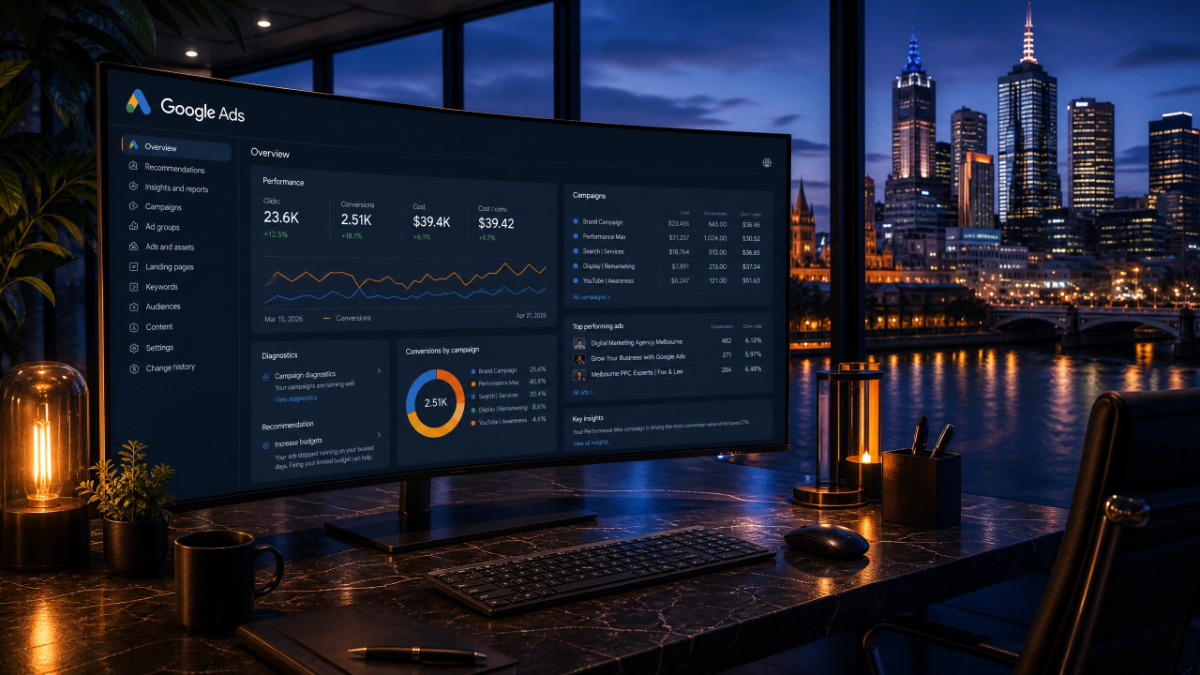
Discover how Fox & Lee compares agency fees, performance benchmarks, and the strategies that drive better Google Ads results in Melbourne.


© Fox & Lee Holdings Pty Ltd 2026