
Online shopping is no longer a convenience—it’s a daily ritual. In Australia alone, over 9.5 million households made an online purchase in 2024 (Australia Post eCommerce Report 2024). From groceries to electronics, fashion to furniture, customers have come to expect quick delivery, seamless transactions, and responsive websites. For businesses, this represents both a major opportunity and a challenge. Creating a successful eCommerce presence is about more than putting products online—it requires strategy, technical precision, and user-first design.
Shopify is a user-friendly SaaS platform with an intuitive interface, ideal for small to mid-size businesses that want to go to market quickly. It offers strong integrations with social media, apps, and POS systems.
Pros:
Cons:
WooCommerce is an open-source plugin for WordPress that gives merchants full control over design, functionality, and scalability. It’s perfect for SEO-focused stores, businesses that want flexible product setup, or anyone needing tailored functionality. WooCommerce stands out as the best platform for businesses serious about owning and growing their online presence without limitations.
Pros:
Cons:
Magento is designed for enterprise-level sellers with complex needs—multi-region, multilingual, or large inventories. It supports deep customisation and robust performance but requires dedicated development resources.
Pros:
Cons:
BigCommerce strikes a balance between Shopify’s simplicity and WooCommerce’s flexibility. It includes more features natively, which can reduce reliance on apps.
Pros:
Cons:
Squarespace and Wix are beginner-friendly platforms with drag-and-drop functionality. While fine for launching a simple store, they lack the deep eCommerce capabilities required for scaling.
Pros:
Cons:
Stripe is a popular choice thanks to its powerful developer tools and seamless checkout experience. It supports subscription billing, multiple currencies, and mobile wallets.
Pros:
Cons:
Trusted by consumers worldwide, PayPal offers simplicity and buyer confidence. It’s easy to integrate but costly in fees and lacks flexibility.
Pros:
Cons:
Square offers all-in-one payments and POS solutions. It’s ideal for retail stores moving online, with seamless integration and competitive rates.
Pros:
Cons:
Buy Now, Pay Later services like Afterpay and Zip appeal to budget-conscious consumers and drive higher cart sizes. However, the merchant fees are among the highest in the industry.
Pros:
Cons:
Afterpay Website | Zip Website
Mobile wallets like Apple Pay and Google Pay streamline the checkout process for users on mobile devices.
Pros:
Cons:
Integrated shipping tools help automate order processing, label generation, and tracking.
Sendle offers affordable carbon-neutral delivery across Australia. Australia Post MyPost Business is reliable and familiar to Australian shoppers. Shippit and ShipStation allow access to multiple carriers from one dashboard.
Pros:
Cons:
Outsourcing warehousing and fulfilment helps businesses scale without expanding physical operations. Third-party logistics providers like eStore Logistics, Fulfilio, or Amazon FBA handle everything from storage to shipping.
Pros:
Cons:
A strong POS system connected to your online store keeps inventory accurate across all sales channels. Square POS integrates with most eCommerce platforms, while WooCommerce users can rely on plugins like FooSales or Point of Sale for WooCommerce.
Pros:
Cons:
Email marketing is essential for nurturing customer relationships and increasing lifetime value. Klaviyo offers advanced segmentation and automation. Mailchimp provides easy drag-and-drop campaigns. HubSpot and Zoho CRM go deeper with contact management and integrated marketing.
Pros:
Cons:
SMS campaigns are short, impactful, and often see instant results. Tools like Postscript and SMSBump connect directly with Shopify and WooCommerce.
Pros:
Cons:
SEO drives long-term organic traffic. Yoast and RankMath are ideal for WordPress users. SEMrush provides broader keyword and competitor insights.
Pros:
Cons:
Digital ads are key to capturing and converting traffic. Google Ads targets buyers actively searching for products. Meta Ads allow for advanced segmentation and dynamic product ads. Pinterest and TikTok help generate brand awareness and social engagement.
Remarketing keeps your brand top-of-mind. Install tracking pixels like the Meta Pixel and Google Ads Tag to deliver targeted messages to users who browsed but didn’t buy.
Pros:
Cons:
Effective strategy is built around customer understanding. Develop buyer personas to define your audience’s demographics, preferences, and behaviour. This informs everything from homepage layout to marketing messaging. Personas should be refined regularly based on data and feedback.
Pros:
Cons:
With thousands of stores online, it’s vital to differentiate. Offer perks like free shipping, bundles, urgency triggers (e.g. timers or stock warnings), and loyalty programs using tools like Smile.io or LoyaltyLion.
Pros:
Cons:
Well-optimised listings convert better. Invest in professional product photography, lifestyle imagery, and concise, benefit-driven descriptions. Use reviews and ratings via Judge.me or Yotpo for trust.
Pros:
Cons:
Your online store should evolve with your audience and analytics. Use Google Analytics 4, Search Console, Hotjar, and A/B testing tools to understand what’s working and where improvements can be made. Schedule regular reviews of performance, marketing ROI, and site health to ensure your store is always improving.
Pros:
Cons:
Partnering with a professional agency gives you access to deep expertise in website design, development, and digital strategy. Agencies understand user behaviour and can craft a site tailored to your customer journey—from homepage to checkout. Custom sites also enable performance optimisation, security enhancements, and third-party integrations that power automation and sales growth. Rather than relying on templates, a custom-built store reflects your brand’s uniqueness and can scale with your business.
Pros:
Cons:
DIY platforms promise simplicity, but the trade-offs can be costly. Without a solid foundation in UX, coding, or SEO, many DIY sites suffer from poor load times, unattractive layouts, and checkout abandonment. Marketing automation, advanced shipping logic, or loyalty integrations may not be available—or come with limited options. These platforms also often restrict ownership and exportability of your data.
Pros:
Cons:
A successful eCommerce website is not just a shop—it’s a business asset. Whether you’re selling locally or nationally, investing in the right platform, tools, and strategy is what sets top-performing stores apart.
Work with a trusted agency, track your data, evolve with your customers, and you’ll build a brand that lasts.
Looking for Custom Website Design for your ecommerce store? At Fox & Lee, we create beautiful solutions. Our Melbourne-based custom website design team understands what it takes to translate a successful business into a successful ecommerce website.
Ready to get started? Contact Us today
Australia’s eCommerce landscape has experienced significant growth and transformation in recent years. In 2024, Australians spent approximately AU$69 billion online, marking a 12% increase from the previous year. (eCommerce-report.auspost.com.au) This surge underscores the growing reliance on digital shopping platforms.
These figures highlight the sustained consumer preference for online shopping even after the height of the pandemic. Retailers that continue to enhance their digital presence stand to benefit from this enduring shift.
Approximately 9.8 million households engaged in online shopping in 2024, marking a 2.3% rise compared to the previous year. (eCommerce-report.auspost.com.au)
This data illustrates that eCommerce is no longer just a trend—it’s a mainstay for the vast majority of Australian households, making it essential for brands to optimise user experience and delivery reliability.
While Millennials and Gen X remain the biggest spenders, Baby Boomers are rapidly growing as a digital shopping force. Businesses should cater to the usability and preferences of older demographics while still engaging younger shoppers with mobile-first experiences.
Understanding generational preferences can inform inventory, UX design, and targeted ad campaigns. For example, fashion retailers should ensure seamless mobile experiences to match Gen Z’s purchasing habits.
Mobile commerce dominance means your website must be responsive, quick-loading, and easy to navigate. Brands that prioritise mobile UX and checkout optimisation will reduce bounce rates and improve conversions.
This suggests budget-conscious consumers are being more selective. To maintain margins, retailers should explore bundling strategies, loyalty programs, and pricing incentives.
Shoppers are motivated by value. Highlighting cost savings, offering promotions, and clearly communicating return policies can encourage trust and repeat purchases.
Even with a focus on price, trust remains a powerful differentiator. Consistency in quality, service, and communication helps brands retain long-term customers.
Speed matters more than ever. Retailers should consider partnering with express logistics services or offering local warehousing options to meet fast delivery expectations.
While fewer businesses are offering free returns, transparency around return policies is vital. Clear, fair terms can reduce buyer hesitation.
Inflation and fuel surcharges are impacting logistics. Communicating realistic delivery fees upfront and incentivising larger orders with free shipping thresholds can help balance customer expectations.
Businesses should diversify their digital ad strategies across SEO, Google Ads, content marketing, and remarketing to stay competitive.
Retail media (ads on marketplaces and retailer websites) is surging. Participating in these networks can amplify brand visibility during critical shopping moments.
This highlights the value of personalisation. Retailers should collect first-party data to deliver customised offers and messaging through email, SMS, and on-site recommendations.
Australia Post, DHL, FedEx, Aramex, and StarTrack remain industry staples for domestic and international logistics. With national coverage, they offer scalability but may lack the speed of new gig-based alternatives.
Retailers can mix traditional and gig-based courier solutions to balance reach and delivery speed. Integrating flexible delivery options during checkout can also improve customer satisfaction.
These platforms dominate with aggressive pricing, wide product ranges, and fast shipping. Competing businesses must focus on niche value, customer experience, or brand storytelling to stand out.
The Australian eCommerce market shows no signs of slowing down. With rising consumer expectations, advancing technology, and evolving competition, staying informed is essential. Businesses that adapt to mobile-first experiences, diversify marketing, and streamline delivery logistics will be best positioned to succeed with eCommerce in the years ahead.
For tailored eCommerce solutions and expert guidance, consider partnering with professionals who understand the intricacies of the Australian market. Fox & Lee are an eCommerce focused agency that achieve great results for our clients. Contact us today for more info.
What you don’t want to happen
During that 6 minute window of opportunity, they spend their time becoming frustrated and annoyed with your website trying to find what they need, till they reach the point where they abandon the site and search for a faster and better shopping experience with one of your competitors, never to return again.
What you do want to happen
Your website loads fast, and that fast page load speed continues throughout your customers shopping spree as they navigate through your website right through to purchase.
Important Point – A fast website not only contributes to a much higher conversion rate on the customer’s first visit, but is also a massive contributing factor to your customers returning within the next 3-6 months to purchase again.
Scoring a Positive Review
When it comes to eCommerce, everything you do should contribute to creating a raving fan and securing a positive review for your store or product. It’s a fact that people are much more likely to leave a bad review when something goes wrong than they are when something goes right. Everybody hates a slow website, so if you want to increase the chances of scoring a great customer review, you better make sure your website is fast.
So, how do you speed up your website?
Now there are plenty of posts across the internet on the topic of Website Speed Optimisation, so our aim in this resource is to highlight and prioritise the easiest things that you can do, with a focus on websites built using WordPress and WooCommerce.
1. Your product images are too big.
Oversized images are the most common cause of slow loading websites, so sign up for an image optimisation service like Shortpixel. Install their plugin, configure and start optimising the images in your media gallery. But, don’t become too obsessed with image optimisation; you want to find the happy balance between an image that still looks nice and sharp but has a compact file size for faster delivery. Great looking images contribute to a higher conversion rate; blurry, pixilated images do not.
Important Tip – I would suggest generating WEP and AVI versions of your images, which Shortpixil facilitates. WEP and AVI are new types of image formats that will allow you to reduce your image file size to be smaller than that of a JPEG or PNG while still maintaining the quality of the image. Both Chrome and Safari support these modern image formats, which are by far the most common browsers people are using.
2. You are on cheap hosting!
If you have an eCommerce website, you need quality website hosting. Unfortunately, most big-name hosting companies are more interested in squeezing as many websites as possible into a shared hosting environment to make as much money as possible. For eCommerce hosting, you should either be on a dedicated server if you have steady, predictable traffic. Or, if you need the flexibility of scaling up quickly to account for a sudden increase in traffic, Cloud hosting is the right choice for you.A sudden increase in traffic can be caused by one of your products going viral or during a peak buying season like Black Friday, Cyber Monday pre- Christmas etc. With cloud hosting, you can quickly allocate more server resources to handle the increased traffic via a quick phone call to your hosting company.
Important Tip – If you are an Australian based company and need a fast response from your hosting provider, I suggest speaking to the guys at Servers Australia. Their support team is Australian based; they offer 24/7 support and provide various Cloud and dedicated hosting solutions.
3. You’re using an Off the Shelf multiple purpose eCommerce Theme.
If your website was built by an agency that does not specialise in eCommerce, or you built it yourself. Most likely, the website has been built using a multi-purpose eCommerce theme that comes with all the bells and whistles. The problem with this type of theme is that it has been created to appeal to as wide an audience as possible to maximise sales. The result of this (from a coding perspective) is a bloated mess that is extremely hard to optimise and maintain long term; when it comes to performance – less is more. Think of your website as a high-performance race car, every gram of unnecessary weight has been stripped away, leaving just the lightweight parts that are engineered to work together to win the race.You may love the look and feel of your website, so the solution may be that you just need to reach out to an eCommerce Developer to strip down your website and rebuild it without all the extra unnecessary weight slowing it down.
4. Too Many Plugins Installed!
Now, let me firstly state, there is nothing wrong with installing wisely chosen, well-coded plugins to introduce the feature or functionality into your site needed to give it the edge over the competition. But, if you have gone ahead and installed a bunch of plugins, each coded by different developers, each doing a separate task, your website speed and reliability will suffer. If you are reading this resourceful information, you are most likely not a website developer and cannot possibly tell a quality plugin from a bad one. But what you can do is complete a simple plugin audit yourself. Login to the backend of your website, review all the plugins that have been installed and deactivate the ones that are not needed. Then check the site’s functionality is not affected and delete the deactivated plugins. By deleting the unnecessary plugins, 90% of the time, you will have contributed to speeding up your website.
Important Tip – If you find a lot of outdated plugins, either update them or remove them, as outdated plugins pose a significant security risk to your website, making your site more vulnerable to hackers.
5. Use a Content Delivery Network (CDN)
By incorporating a CDN, you can significantly reduce your website load time, especially if it is image-heavy like an eCommerce website. In simple terms, the benefit of a CDN is that it will load your website content from the nearest data centre to your customer. So, for example, if you are an Australian based company selling in the USA and a customer from California is shopping on your website, you would want the website loading fast from the nearest data centre in the USA, not from Sydney, Australia.
Important Tip – Choose your CDN wisely, make sure it has data centres in the countries you are targeting and make sure it is a paid service. There are risks with using a free CDNs service, as some countries have internet providers that block free CDNs as it loses them revenue. The two largest Telecommunication companies in Australia are guilty of this, forcing websites to load from overseas data centres without you knowing. But if you are paying for the CDN service, that means the telcos are getting a payment passed on, and your website is much more likely to load from the location-specific data centres as expected.
In conclusion
The five points listed above are items you can largely do yourself. However, beyond this point, further optimisation becomes a highly technical and specialised skill, where you need an experienced developer with solid experience optimising websites, which is where we excel.
If you would like to discuss further how we can assist you in speeding up your website, please feel free to book in a call to discuss further.
eCommerce changes every day. With the user experience improving and technology offering us new advantages at a rapid rate, customers will demand an optimised ecommerce experience from your website. Want to make sure you’re ahead of the game and have these things on your site? Read on – we’ve listed a few trends that have been around for years and are here to stay into the late 2020’s.

Get ready for the invasion of robots into ecommerce online stores. Infact – chatbots are already here and being widely used on more ecommerce sites than you might think. Chatbots and Ai functionalities will take over tasks from humans and improve the user experience in your online store. Live chat can be started by Ai and help customers by recognising keywords in their conversation and providing options that fit the keyword criteria. When the bot can no longer answer the question, the customer is discretely maneuvered to a human live chat manned by your staff. This is great for customer service and retaining the user on your site and excellent for freeing up staff resources. Time to invest in a bespoke functionality to enhance your online customer service.

People have gotten used to online shopping, but nothing beats the feeling of actually holding the product. Augmented reality and 3D are coming pretty close in offering customers that sensation, but that’s a little more into the future yet. HERE’S A PRO TIP: Implement video content to give users a better idea of what your product looks like. People like to see other people and if they can see your product in the hands of another human then half the sale is done. Video will give users an idea of real size, colour, texture and quality. Back your video up with some great images and you’ll find users are more like to “add to cart”.

Voice search is growing rapidly, and your ecommerce store needs to adapt to this. Since more and more purchases are made through Alexa or Google Home, ecommerce businesses should focus on long-tail keywords to capture this audience. Sound a bit confusing? Get in touch with us, we specialise in ecommerce website and we can help with this.

Take your related product to the next level, and show products your users are actually interested in. With tools available for deep personalisation, it becomes easier than ever to show the right message to the right people.

One of the biggest killers of an online purchase is an old and sluggish payment process. If you have an outdated, old or lengthy checkout process on your ecommerce site then it’s time to upgrade asap! The checkout processes has become so simplified with web payment services such as Apple Pay or Google Pay, customers can purchase items with a simply click. Say goodbye to lengthy forms for customers to fill out and an array of confusing options to choose from – quick, easy and seamless is the way to go and this is one trend that is not going away.

Consumers are getting more aware of their carbon footprint and the impact ecommerce has on the earth. In order to win over the users’ consciousness, you have to strive for total transparency.

Your website is not the only platform driving you sales anymore. Social media channels are playing a bigger roles in generating sales, meaning ecommerce businesses should get more experimental with different ways of social media. With in-app purchases, Google shopping and market-place avenues, the platforms are endless in which you make a sale.
We specialise in ecommerce website design and development and all things that go hand-in-hand like ecommerce SEO. If you need to ramp up your ecommerce store and catch up to what your competitors are doing then get in touch with us – we can help.
For months. locked down Melbournians relied on online shopping for their retail therapy. But the convenience of shopping from home from thousands of different retailers online won’t be lost when shopping centres re-open. It’s never been a better time to own an eCommerce website design in Melbourne.
From looking at Google trends we can see that searches for online Shopping are up 60% since mid-June and a staggering 75% since February in Victoria. There is so much demand but there is also a lot of supply. So, how can you make your products stand out from your competitors?
Let’s have a look.
If you offer Afterpay, Zippay or any other pay later service, you’re going to attract the business of shoppers who love impulse shopping. You’ll also feature their business directory, feeding you more customers.
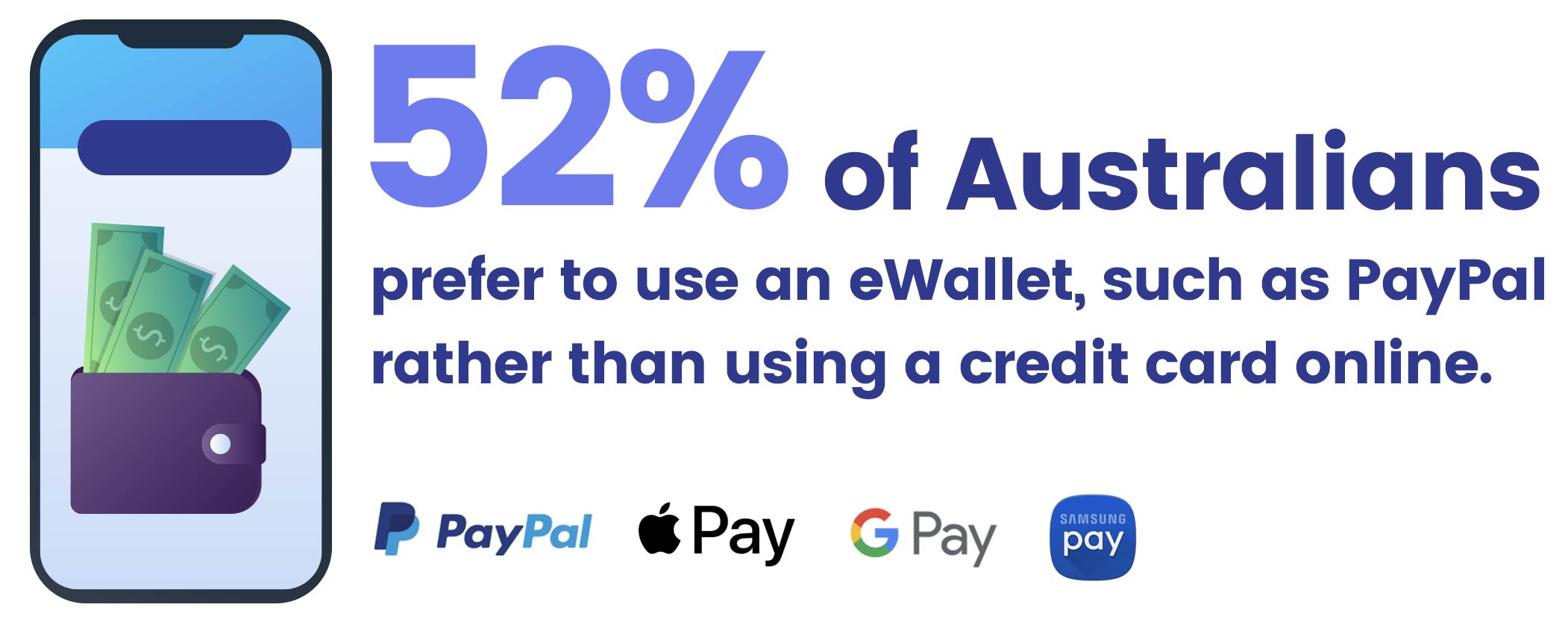
52% of Australians prefer to use an eWallet, such as PayPal rather than using a credit card online. With the extra security offered, it’s no surprise. So this is another payment integration you can’t overlook in your eCommerce website design.
Or maybe you just want to use a specific payment gateway with lower fees than what’s automatically provided in self serve website builders. Thus, giving you the ability to compete with other websites on a price front.
The important thing is that your digital strategy isn’t hindered by an inability to support the payment services you need to offer. Custom website development allows for the integration of different and complex payment gateways on your online store.
We can’t stress enough the importance of investing in professional product photography. Letting your customers see what they’re buying builds trust in the product and significantly contributes to your chance of a sales conversion.
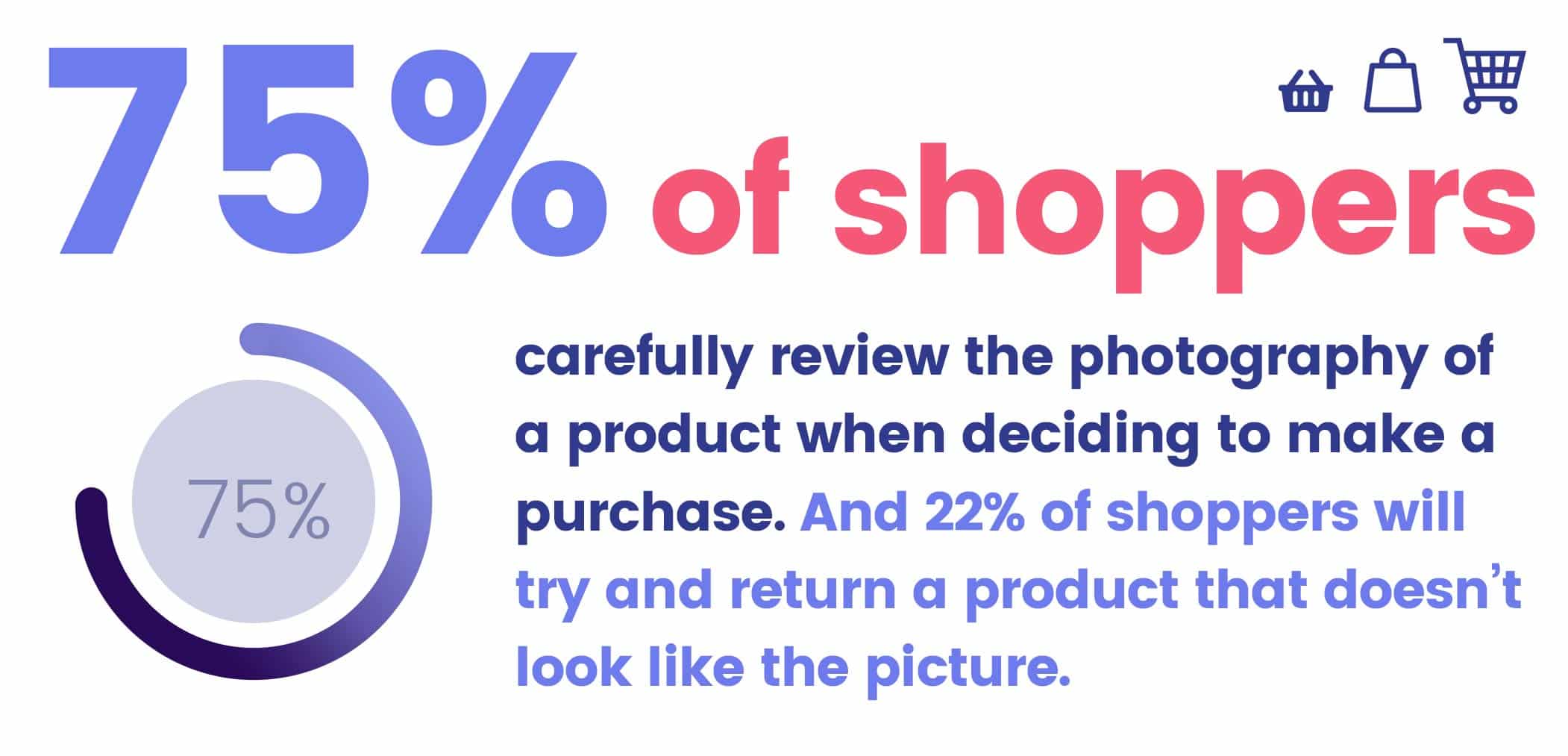
75% of shoppers carefully review the photography of a product when deciding to make a purchase. And 22% of shoppers will try and return a product that doesn’t look like the picture.
Photos off your phone might be fine for sites like eBay and Gumtree. When it comes to your eCommerce business, not investing in professional product photography can end up costing you in both sales and returns.
If you’re not the only person selling a certain product online, make sure you’re doing it better than anyone else. Take the time to not only invest in high-quality pictures but also high-quality copy.
Use the descriptions on your product pages to write an interesting piece of text about why customers should purchase the item. Outline the features and benefits of your products. Don’t just copy and paste in the technical specifications from the supplier.
Not only will this work to strengthen the conversion rate for your eCommerce website design in Melbourne, but it will also help you stand out from competitors who aren’t doing this and position you as an expert in your niche.
Responsive Website Design is a necessity in today’s online shopping climate. This means making your website work flawlessly across Desktop, Tablet and Mobile.
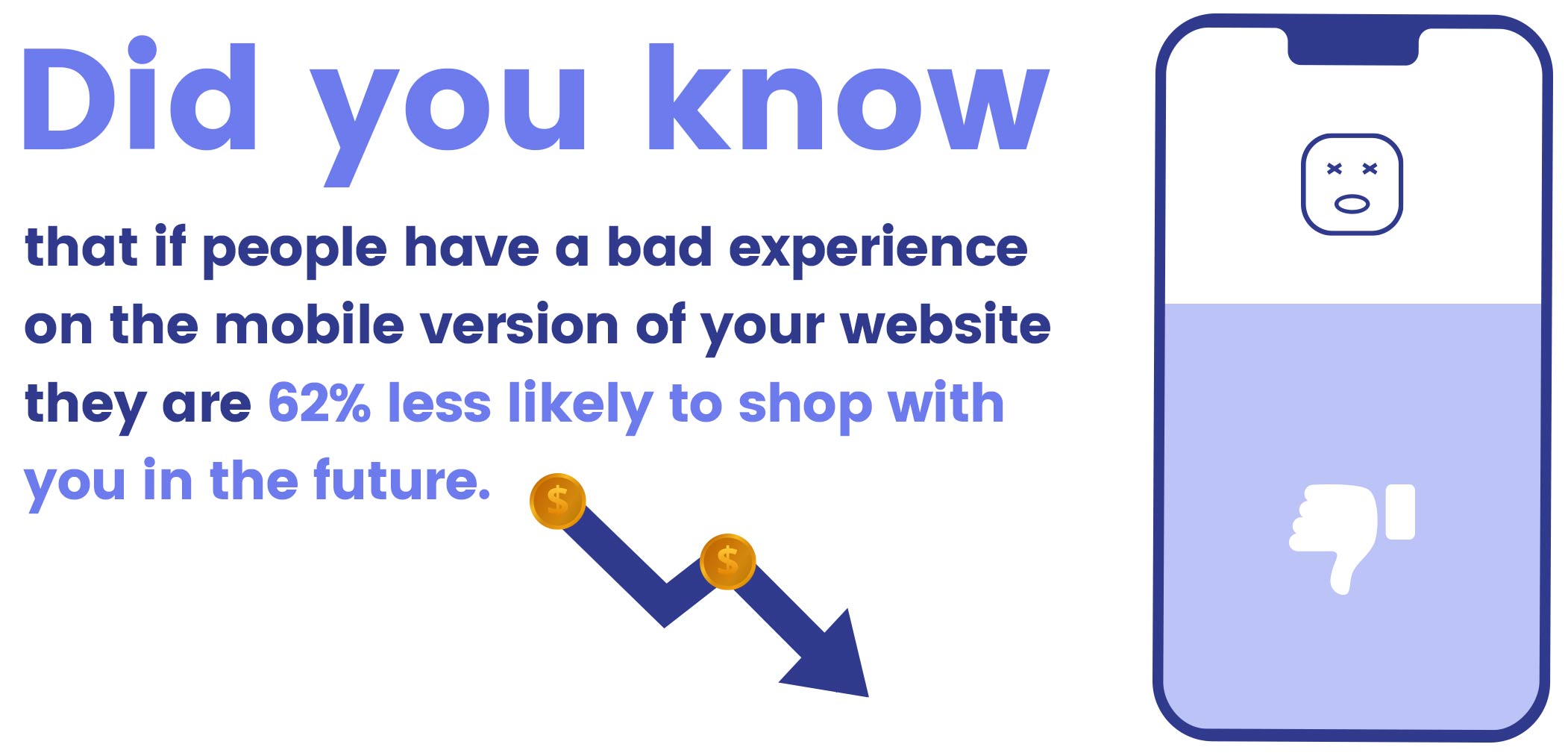
Did you know that if people have a bad experience on the mobile version of your website they are 62% less likely to shop with you in the future?
With search engines and social media making it easier than ever to find products online, you can’t afford to make mistakes that disengage potential customers.
Setting up the ability for customers to review the products they purchase from your eCommerce website can be easier than you think. Web developers can integrate product reviews to seamlessly populate below each unique product as customer feedback comes in.
We can even set up automatic reminders that generate and send an email form for your customers to review multiple items from their last purchase. It then feeds the responses straight into your website.
Why is this something you need? Customers trust the authority of other customers. A website full of glowing testimonies is an effective way to remove hesitation from a new customer’s mind when they are on the fence about a purchase. If the customer has viewed the same product on multiple sites but your website is the only one with great product reviews, and the pricing is very similar, your store is much more likely to get the sale.
If you want to highlight your products, there is no better way than setting up your Google Merchant Centre and Google Shopping. Customers will see your product and it’s description up against similar products from competitors.
If you’re using part of your advertising budget on Google Shopping, then you’re reaching customers who are looking specifically for your product. What that means for you is a higher click and sales conversion rate. That’s a great return on investment.
Highlighting and showcasing your products makes your eCommerce business stand out to shoppers across Melbourne. There’s a lot of competition out there, but experts in web solutions like Fox & Lee can support your business to reach more customers and grow your eCommerce revenue.
Ready to learn more? Either give us a call on (03) 9043 1039 or contact us here. Together we’ll start developing a strategy for your business that improves your bottom line and elevates your eCommerce website design in Melbourne.
Does this sound familiar? You have great products on your eCommerce solution, your customers love you, but your revenue growth has become stagnant?
Don’t worry, because an expert eCommerce agency like Fox & Lee can help you identify why this is happening and deliver solutions that help elevate your business and increase your sales.
Let’s have a look at some of the different ways together we can make your eCommerce solution more profitable for your business.
You want your website to stand out, for the right reasons. It’s important your website is a professional reflection of your business. You might find a template that looks great and resonates with your target market but compromises the finer details that lets your business’s unique selling points shine through.
We recently redesigned an eCommerce business which resulted in a Revenue Growth of 135.38% in the first month! It shows that redesigning a website is an investment that will contribute direct results to your bottom line.
When you use ecommerce web design professionals like Fox & Lee, we can take all the things you love on a website and pair it with attention to detail that will hook your customers and convert users into shoppers.
The next challenge is having a website that looks great, everywhere. Your eCommerce solution needs to be engaging to the same level across desktop, mobile and tablet. This is where responsive web design comes into play.
Statista reports that earlier this year 51.53% of all web traffic was coming from mobile devices. Imagine if 51.53% of your customers can’t engage with your online store? That’s going to hurt your sales.
Using a professional agency like Fox & Lee ensures the website isn’t only developed to work across devices, but it’s also put through rigorous testing to make sure everything works perfectly.
Does your target audience love using pay later services like ZipPay or AfterPay? Then it should be on your website. We can integrate features such as different payment gateways or complex shipping solutions onto your website with ease.
As an example, AfterPay advertises that their retailers who use them experience a 30% increase in new customers, an average order increase of 40% and a 22% increase in cart conversion. Optimising your website to offer the flexibility your customers expect while shopping online is an easy way to not only remain competitive but directly influence your sales revenue.
Do you use MailChimp, CRMs or Social Media? We can integrate them into your website to make it easier to manage, saving you time and allowing you to spend that energy in sales-focused activities.
It’s easier to keep your customers engaged by automating follow up emails or creating targeted messages with special offers and sales events. We can help you strategically time requests for reviews to maximise the likelihood of a response which helps promote your website.
Build it and they will come? Not always. You need to help your customers learn where to find you. Online Marketing can include Search Engine Advertising or Social Media. But, in a nutshell, it’s about getting your message in front of potential customers.
Experts like Fox & Lee develop targeting strategies to design advertising that is results-oriented and targets customers most likely to convert on your eCommerce solution. You can do it yourself, but you’d be wasting money that professionals use to optimise your strategy and deliver a measurable return on investment.
SEO done right is a lot of moving parts. A full-service web agency can optimise each part to achieve the best results possible. We combine content marketing with website optimisation and maintenance to make Search Engines love your online store.
We take the time to pick out keywords that are achievable to rank for, as well as genuinely traffic generating. What this means for you is SEO that is maintainable and puts your business in front of competitors.
Are you ready to increase the bottom line of your eCommerce solution? Give us a call on (03) 9043 1039 or fill out the form below. Then we can work out what bottlenecks are hurting your business and what measurable and achievable solutions we can put together to overcome them. Together, we can grow your online business and achieve your digital goals.
"*" indicates required fields
There’s nothing more frustrating than spending money on generating traffic to your website and not seeing those potential customers buy anything. Whether it’s a high bounce rate or cart’s being abandoned, it makes you wonder, why aren’t customers staying on your webshop?
Fox and Lee are experts in User Experience (UX) design and understanding of the customer journey. Turning customers from ‘just browsing’ to ‘just shopping’ is what we do best. So, we’re able to offer insights into what factors may be behind your low website conversion rate. To do this we’ll explore the journey of where your customers are coming from, to the greeting they receive from your landing page. And what roadblocks you have the power to remove from that journey.
It’s important to think about how your customers find you. Are you running any marketing campaigns currently? Most paid online advertising channels offer audience targeting on their platform. This is a key opportunity for you to qualify your incoming traffic. Google lets you target people who are actively considering a purchase. If you know what interests your shoppers generally have, then that can be a focus in your social media strategy.
Digital Marketing isn’t just about bringing in more traffic. When you work with a digital strategist, it’s about finding the right traffic. If you have an effective marketing campaign set up, you’re more likely to have people who are likely to convert visiting your website.
Part of this is considering what messaging customers are exposed to when first being made aware of your brand. If your paid-advertising or organic efforts are disqualifying your audience in the awareness phase, you’re only setting yourself up for more work later on. What might that mean? Maybe you’re running a campaign for a specific product. You wouldn’t want people to become unaware of your other offerings from this and think that’s the only product you have to offer. Remember the big picture.
You want to connect with the right audience and you want to be saying what they need to hear. If the right customers aren’t visiting your webshop, it might be because you’re not talking to them.
Search Engine Optimisation (SEO) involves a lot of moving parts. How search engines crawl and index your pages has a huge effect on who will find your website. Keyword strategies are implemented to make sure if a customer is looking, they find you. Without those strategies though, more of the wrong people might find you.
Obviously not ranking for desired keywords has the adverse effect of the customer you want not being able to see you. But, you can also rank for keywords that are irrelevant to your business without even knowing it. This will bring more traffic to your website who aren’t likely to buy anything.
Working with an SEO strategist means you’re again, qualifying your incoming traffic. You make sure you’re visible to the right people and not the wrong ones. Aside from the increased visibility and traffic brought on by SEO, it’s also a very targeted way of filtering who lands on your website.
So now we have the right person on your website. The next problem is getting them to hang around. A metric known as your bounce rate shows how many people click straight off your website. This sucks. You want people to click through your website, discover who you are and what you offer them. If you’ve lost them in seconds of them finding you, then this is a huge problem for your business.
UX design refers to when we build a website that isn’t only beautiful but functions with the focus of the experience your users will have online. This means well-functioning menus. Clear information that is easy to read and visualisation that help sell your offering. It’s about looking through the customer’s eyes and making sure they can quickly identify they’re in the right place and they can find what they need.
Building a website without UX design significantly lowers your chances of website sales conversion. Your website is an investment into your business and it is important for it to become a selling tool that contributes to your revenue. Not having a UX focused design is a reason why customers aren’t staying on your webshop.
We’ve got your customer interested and they’re now browsing your website. The next hurdle we can face is them not being able to find what they are looking for. Does your website have a search bar? Does it work well?
How are the categories laid out? Are titles vague or do they clearly communicate what can be found on each page? The ability to navigate and explore your website it’s just important for people finding that one thing they’re looking for. You should always aspire to increase your basket size and the value of your average transaction. Your website needs to make finding things that are relevant to your customer easy and natural.
This is another way in which a lack of customer-centric design hurts your business. Fox and Lee can work with already established websites to redesign or improve what’s there and increase your sales with our strategic design capabilities.
Have you ever been in a shop where it’s cash only but you only have card? It’s quite likely you didn’t end up buying anything. Whether it’s the payment integration or a lack of shipping availability, if your customers aren’t able to purchase what’s in their cart the way they want to, there’s a good chance they won’t.
Our developers are able to include complex shipping options or API integration that expands your payment options in your webshop. This stops them from giving up and going to look somewhere else.
Your website always needs to be focused on your customer’s needs and experience. If customers aren’t staying on your webshop, it’s likely their needs aren’t being met. The good news is, this is never too late to fix.
Fox and Lee are award-winning web designers who specialize in UX design and eCommerce solutions. We can create the features and functions your website needs to be successful. We are a full-service agency who are committed to working with you over the life of your website. This includes an offering of care plans and digital marketing services to grow your business.
Here at Fox and Lee, we are a proud member of our local community. When Melbourne based Businesses are looking to grow themselves with eCommerce Web Development, we are happy to lend a hand.
We offer expert design and advanced development specialities (such as CS-Cart mastery). Thus, you can trust us to transform your online presence to a strategic representation of your business.
We are committed to being apart of your online journey. We support your business as it grows online and different opportunities arise.
Here are three of the many examples of eCommerce Web Development where we developed a web solution for local businesses.
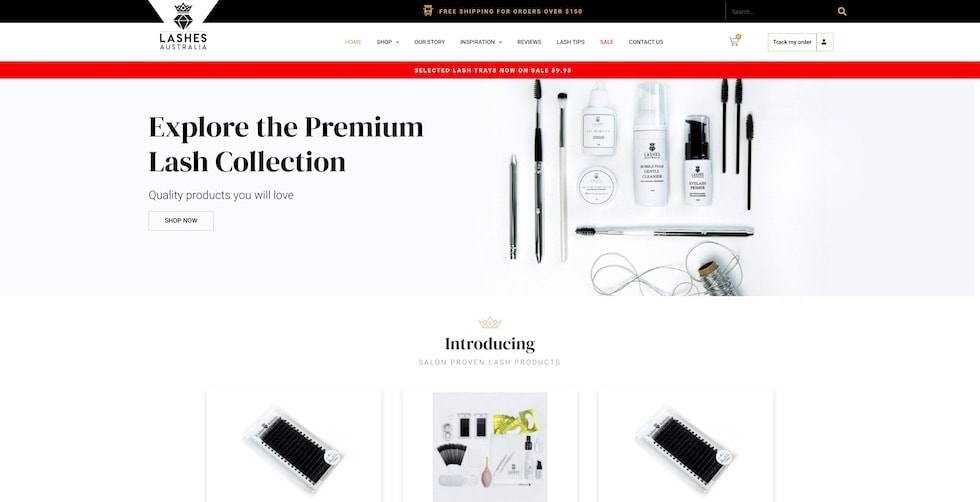
Lashes Australia is an exclusive online supplier of quality lash products. Upon visiting, you’ll notice they proudly express their core values of great customer service quality product throughout their website.
This design is bright and clean and highlights their product. Similarly, messaging is clear with key promotional details highlighted using impactful banners. Language including ‘Premium’ and ‘Quality’ reinforces their brand promise.
By including a page about ‘Lash Tips’ Lashes Australia position themselves as an expert in the industry. Additionally, they invite reviews on each product in their range. Lashes Australia is proud of its brand and products. Hence, they let that shine through with their online presence.
Lashes Australia is a wholesaler of lash extension and accessories. The transparent nature of the features included in their eCommerce web design reinforces the integrity of the brand. As a result, this speaks to their target audience, being businesses and professionals in the industry.
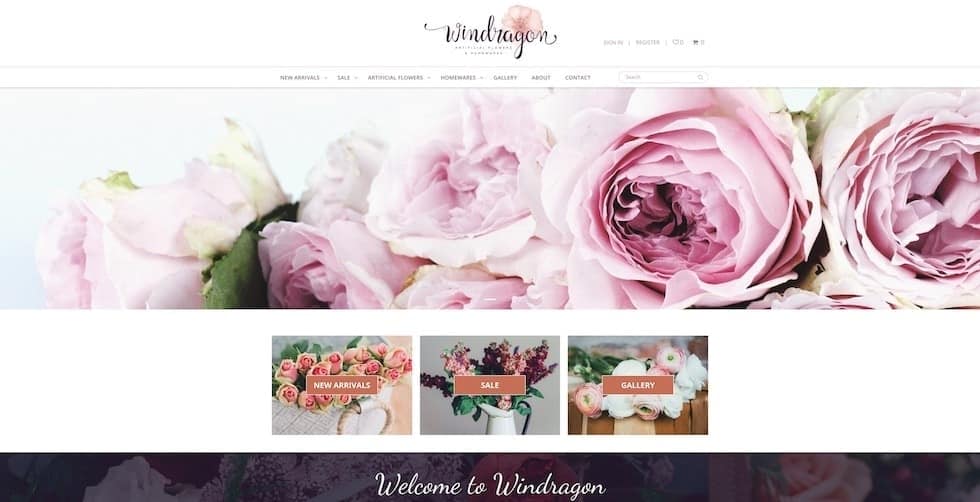
Windragon let pictures of their products do the talking on their homepage. Beautiful flowers are everywhere you look. The use of imagery acts as a strong selling tool.
Windragon’s website features an easy to navigate menu system. They’ve also included a Gallery in their web design that showcases their beautiful artificial flowers.
This website is customer-centric and makes getting in contact clear the user. The customer service provided with a user-experience focused design represents the company’s values in a digital format.
The ordering system was a key part of the development of Windragon’s website. Because of this we sorted out the backend for them and left Windragon with an easy to use web experience.
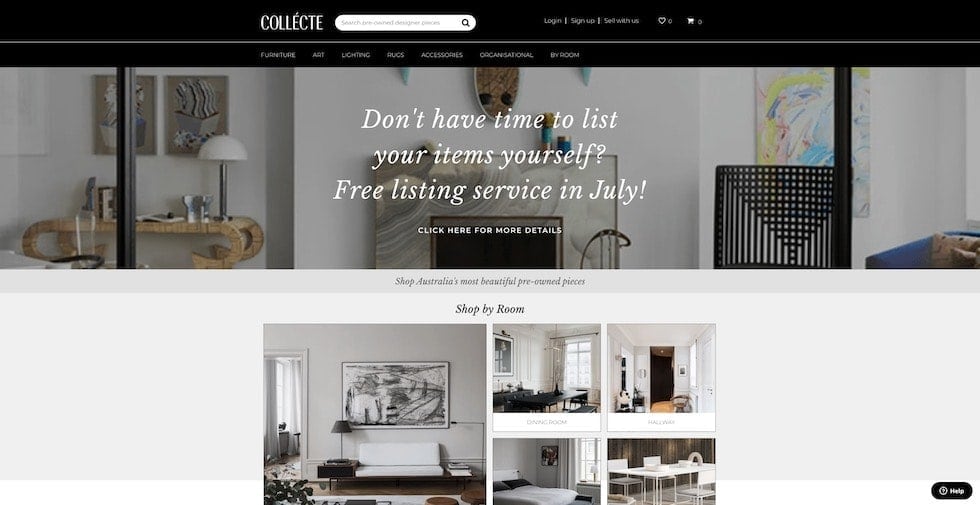
Collecte had the great idea of setting up a marketplace that focuses on preowned designer furniture.
As a Multi-Vendor eCommerce website, Collecte balances both customers and vendors landing on their homepage. Easily identifiable paths of navigation are laid out to both audiences. For example, separate help centres exist for vendors and customers in the footer of the page. Collecte manages dual requirements with specific functionality catered to each audience.
Their website’s integrity is managed through a range of features, such as a review system for vendors and an approved list of designer categories eligible for selling on the site.
Additionally, their website design incorporates a range of elements that make their website unique. Attention to detail positions Collecte to meet their customers needs no matter how varied they may be.
The best part of this website is that with all these moving parts, Collecte still feels undemanding and natural to navigate for the user.
Collecte launched this year. We’re excited to see how they grow and develop as more people discover this one of a kind website.
Here at Fox and Lee, we create Strategic Digital Solutions and Ecommerce Sites that elevate your business. We think your website deserves better than a template.
We’d love to be a part of your eCommerce Web Design website design. Please get in touch with us on 03 9043 1039 or by completing the form below.
Related Reading: 5 ways to make your ecommerce solutions more profitable
The ecommerce industry is incredibly competitive, but we probably don’t have to tell you that. With more than half of start-ups failing these days, you need to have your strategy on point. We know it’s not as easy as it sounds, but a strong online store is a good start.
There’s a lot involved with setting up your online store, which also means that there is a lot of room for mistakes. Well, we listed some of those most common mistakes found in ecommerce stores today. They’re often easy to avoid but could have a huge impact on your conversion rate when corrected. Let’s have a look at how you can grow your sales by avoiding these 13 mistakes in your ecommerce online store.
When users get to your website, you want them to easily find their way around. The lack of clear navigation will leave your users lost and confused, and will thus decrease the chances of them actually buying your products.
By installing a clear menu with your main categories and subcategories, users will know where to go and will be able to shop around easily. Another tip is to follow common design practices when implementing navigation. Although it might be tempting to show your creative side, implementing non-standard navigations will often have a negative effect.
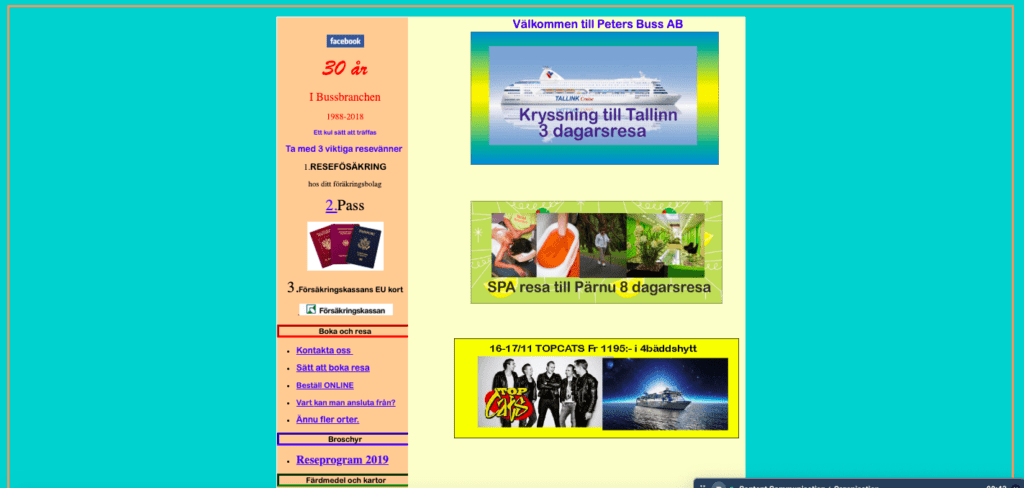
Source: Neil Patel
In line with clear navigational elements are breadcrumbs. Breadcrumbs show users exactly where they are on your website, showing the category and subcategories of the products they’re viewing. By showing this hierarchy, you reduce clutter and it’s easier for customers to backtrack.

Woolworths shows navigational breadcrumbs so you know what category and subcategory you’re viewing
Breadcrumbs don’t need a fancy design. Just the name of the category groups, separated by arrows or dashes, will do. It is, however, necessary that they link back to the right pages – otherwise, it can function as a useful navigational element.
Don’t underestimate the power of visuals. You might be selling the best goods you can think of for the lowest prices imaginable – if your design looks crappy, you won’t make as many sales. People love things that are aesthetically pleasing and your ecommerce store is no exception.
Designing your ecommerce store is something you definitely shouldn’t do alone – unless you’re an experienced web designer – since you want an online store that has a modern look and feels while also offering the users a pleasant experience. We recommended hiring a web designer with extensive knowledge in ecommerce web design, so you know the design will be conversion-optimised.
Although we could write a whole guide on SEO (as a matter of fact, we did – and you can find it here), there are a couple of SEO aspects that shouldn’t be overlooked when it comes to ecommerce.
First of all, make sure there are no broken links on your website. Your online store will probably consist out of a lot more pages than your average website, so you need to ensure all of these still function well. You can use a tool like Screaming Frog to help you out.
Secondly, all the links that do work should be findable by the bots that crawl your website. This means there should be links going from your homepage to every single page of your website.
Lastly, you should optimise all the different tags on your landing pages. This includes the alt-tags for your product images, your heading tags and page titles, so the search engines can rank your product pages accordingly.
While we’re on the topic of SEO, we’d like to point out the product descriptions. These could have a huge impact on your rankings in the search results.
A lot of ecommerce stores simply just copy paste the product descriptions they get from their manufacturer or supplier. By doing this, you’re just implementing duplicate content onto your website – a big no-go for the Google Bots.
Try to write your own product descriptions and, more importantly, keep your target audience in mind. With manually written product descriptions, it’s easier to write about exactly those features that will convince your target audience. It also gives you the opportunity to really stand out from your competitor.
This should be a no-brainer, but we like to include it just in case. People shop on-the-go which means your website should work just as fine on a tablet or mobile as it does on a desktop.
There are still a lot of ecommerce stores out there that start building their online store on a desktop, without keeping their mobile version in mind. Afterwards, they create a responsive version or a mobile website, meaning they have to try to fit all these elements into a smaller screen.
Best is to have two approaches. One platform for desktop-shoppers, and one for a screen that fits in your hand. It’s up to you what works best: a responsive website, a mobile website or a dedicated app – but if you need some advice, a responsive web designer will be able to help you out.
It’s not only the design of your online store that should focus on mobile users but also the user experience of your shop. People that shop on smaller screens use the search function a lot more, find it often harder to navigate around your mobile shop, don’t want to fill out as many forms when creating a profile and prefer an easy check-out process. Make sure you optimise your user experience for both desktop and mobile users.
We already mentioned it, but we’ll go into more detail now about the search function of your website. As we said, it’s mostly used by people on mobile – since menus are often hidden or just harder to navigate with a thumb – but also people on desktop or other devices use it to quickly find what they’re looking for.
First of all, we would like to point out that people who use this function are more likely to convert. Why? Because they know what they’re looking for. They aren’t just shopping around but are looking for a specific product. Which obviously means they’re further in the buying cycle.
So what if they look for a product and it doesn’t show up in your search results? Well, they will leave your website and go to your competitor. When you don’t have the product, this might seem unavoidable, but maybe you can show related products (in a different colour for example) that the searcher might be interested in as well.
Another reason your site search doesn’t show any results might be because the user didn’t use the exact keywords that match the product name or description. Let’s say your potential customer searches for ‘black bag for women’ but your products don’t show up because they’re named ‘black women handbag’.
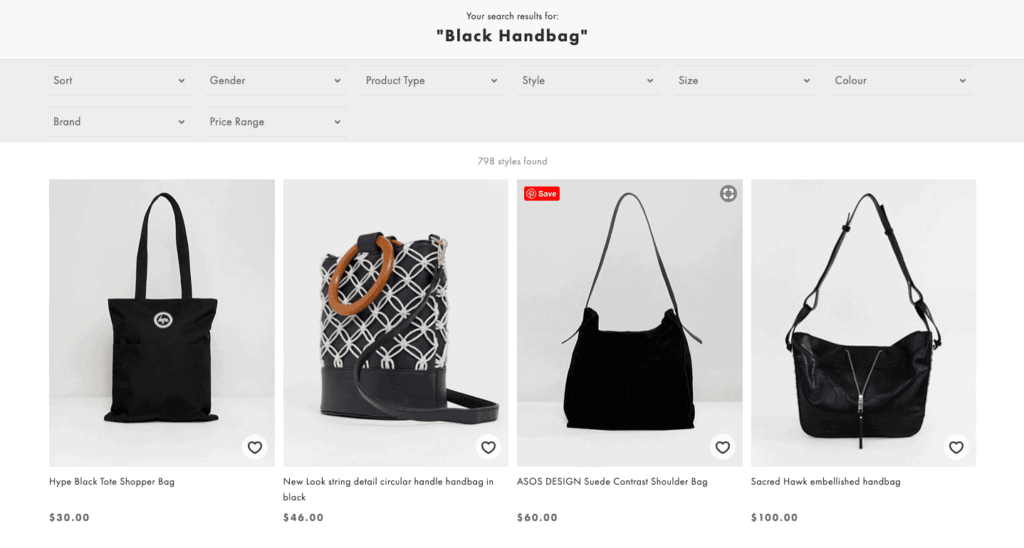
Asos shows all types of black bags when searching for handbags
We know it can be a long and complex process to get your search function working well, but again, think about the likelihood of these people converting. Hire an ecommerce web developer, who can ensure your search function drives you more sales.
Another very common mistake that ecommerce stores make is the lack of a clear brand story. We’re not saying you need to have a whole story written out on your website somewhere (although we do recommend including this on your About Us page), but you at least need to have a clear idea of what your brand stands for.
This includes your mission, vision and what you value. Why do you sell these items? Who are you trying to reach? How is this reflected in the products you offer and the branding you use on a website?
Obviously, this brand story should also be represented in your logo, brand colours and the images that you use on the website. Make sure you keep your brand consistent (both on your website and on social media) so your customers get a seamless brand experience across all marketing channels.
Do you remember the days without internet? You would go to a certain bakery because your neighbour had told you their bread was yummy. You would pick a hairdresser because your auntie’s hair looked fabulous last week. It was all about word-of-mouth referrals, where you would trust the opinion or experience of somebody else.
It’s no different these days – we still trust referrals more than anything, although they changed into an online version. Reviews, ratings and testimonials became extremely important and will make the difference between a sale or not.
Reviews are needed for the products you offer to convince the customer of its quality and benefits. However, you also need reviews for your company or online store itself – so people know you can be trusted when it comes to payment and shipping procedures.
Reviews can be collected on your website (which we would recommend for product reviews), on social media or on Google. Try to get a few on each, since people have different preferences when it comes to checking reviews. There might be a website in your industry that collects reviews and ratings of different shops too.
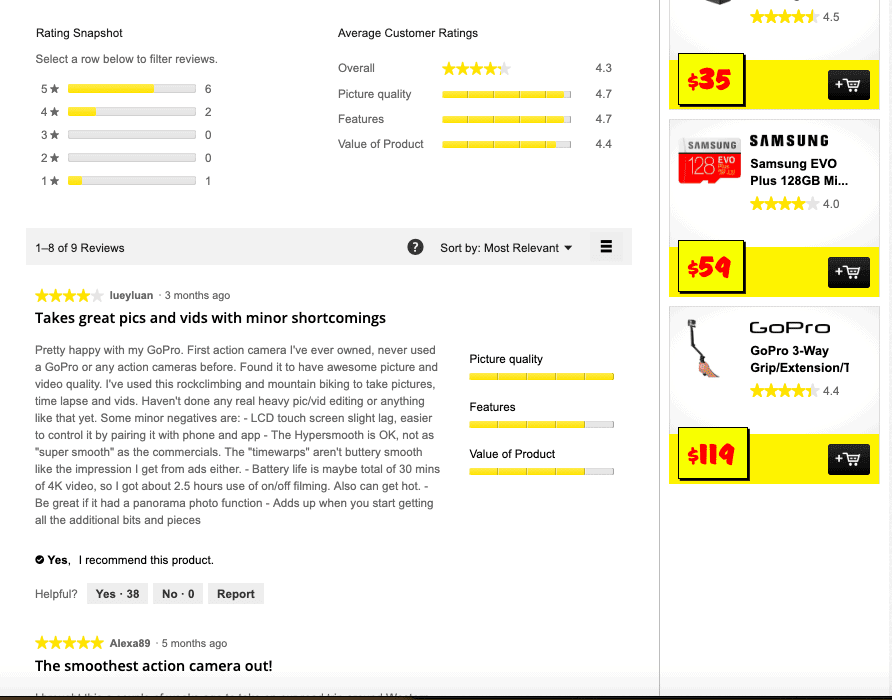
Reviews of the GoPro Hero7 on JB Hifi
This mistake should be avoided at all costs since there is nothing worse than your sale slipping through the cracks last-minute. Your customer already decided they want to purchase your product, but due to a complex or inconvenient check-out process, they abandon their shopping cart or click away right before the payment.
Bad check-out experiences can happen for various reasons. Asking more details than needed is often a big one, just like too many steps or forms to fill out. The lack of certain payment methods is another reason customers could exit at the last minute. And lastly, unexpected costs that are added last minute could really hurt your sale rate (and brand image).
When we talk about the site structure, we mean both the way you organised your pages and the way you categorised your products. It all starts with dividing the products you offer into meaningful product categories.
By choosing the right categories for your products, your customers will have an easier job finding what they’re looking for. You want to create categories that aren’t too broad, but you also have to watch out with going too specific since you want to show at least a few products for every category.
Once you’ve decided on this, you have to create separate category pages for every product group. Don’t forget to include filters, so your visitors can adjust their preferences and quickly browse through the items that they’re interested in.
We know you might have a lot to say. You want to start a summer sale. You’ve decided to offer Free Shipping for 2 months. You have a newsletter you want to share. And visitors can play a game for a discount code. That’s great – the more incentives the better. But please, don’t put them all in a different pop-up screen.
People don’t like pop-ups. They interrupt with what they’re doing. They often don’t even read them before clicking away. Sure, it’s a good practice if you have something really exciting to say. Like an extra discount that can be applied immediately. But try to stick to a minimum when it comes to announcements popping up all over your online store.
And lastly, we want to point out the importance of a good CMS. Don’t try to reinvent the wheel. There are so many good ecommerce platforms available these days, that it would be crazy to try to replicate these.
We know you might need a custom solution that works exactly right for your business. The available platforms are, however, highly customisable when in hands of experienced developers. We would recommend letting one of these guys do their magic, so you can work with a platform that suits well.
Whatever platform you decide to chose depends on your personal preference. We are huge WooCommerce-fans and love its functionality and design options. Talk to an ecommerce web developer (yep, that’s us) to find out more about what WooCommerce can do for your business.
Are you looking for custom web development for your ecommerce store? Then you’ve probably been wondering if you should choose a template or invest in a custom web design. The debate has been going on for years, and even though both have their advantages, we’d like to point out why we would always opt for custom designs for online stores.
We know it’s more expensive and that’s probably reason number one for people to choose templates instead. But the benefits of a custom web design are significant compared to the cost of it. We’ll run you through the most important benefits of custom website development for ecommerce – so you can make up your mind yourself!
First of all, custom web designs give you the option to fully personalise your webshop. While templates let you pick your colours and insert your own logo, you won’t be able to match your website exactly with the brand image you so carefully worked out.
A custom web design lets you decide on every pixel that goes on your website. You can tweak your fonts, colours, product images, tone of voice, filters, grids and menus until it is a perfect reflection of your business.
Also important is that it will give you the possibility to differentiate yourself from your competitors. And with so many ecommerce stores available these days, it is important to do things differently.
Since you can only slightly adapt a template, you might end up with a website that looks more or less the same than any of these other ecommerce websites. Customizing your website will give you the opportunity to stand out from the crowd and attract new customers.
If you want to rank well in the search engine results, we would recommend investing in a custom design. Since it’s built from scratch, you can literally adapt every piece and bit to fit into your SEO strategy.
We know, templates have a couple of SEO tools available, like the option to add alt-tags or keywords. But you can’t change much about the coding that’s used behind the scenes.
Custom ecommerce stores give you unparalleled control over your SEO. This also means that you can quickly adapt when an algorithm update rolls out or if you see any other drops or changes in your traffic.
A custom website design is specially made for your ecommerce business. This means it’s fully adaptable to the unique requirements of your shop. You can decide how many pages, how you want to display your products, what filters and features you want to implement and what social channels you want to connect.
And even better, if your business grows, your website grows with it. Since the ecommerce store is made for your unique products it will be easier to implement new functionalities and products when you expand. A custom web design means you won’t have to upgrade your website in a couple of years, but it will stand the test of time.

And lastly, a custom design is not only beneficial for your store but also for your customers. Since you can decide how every part of your website is going to look like, it’s easier to keep your target audience in mind.
This customer-centric approach lets you really follow the customer journey of your potential customers. You can reach them with the right messages and optimise conversion paths to get drive more sales.
Want to hire an ecommerce web developer? Here are some tips.



