
WordPress Care Plan & Website Maintenance Benchmarks 2026
Compare WordPress care plan costs, inclusions, response times, and risk benchmarks for Melbourne businesses in 2026.

See how SEO, GEO, and AEO help Melbourne businesses stay visible in AI search.

Search has changed significantly. What began as traditional search engine optimisation (SEO) — helping websites rank in Google — has expanded into AI-driven search, where answers are generated and summarised across platforms.
Today, people search differently. They ask questions in ChatGPT, see Google's AI Overviews, use voice assistants, and expect quick, reliable answers. This shift has introduced two newer optimisation approaches: Generative Engine Optimisation (GEO) and Answer Engine Optimisation (AEO).
For Melbourne businesses, this change matters. AI-generated results are reducing clicks to websites, with studies showing organic click-through rates can fall significantly when AI Overviews appear, while zero-click searches continue to increase.
Relying on traditional SEO alone is no longer enough. Understanding how SEO, GEO, and AEO work together is becoming essential for businesses that want to stay visible as search continues to evolve.
At a high level, SEO, GEO, and AEO all aim to improve visibility, but they do so in fundamentally different ways: SEO decides where your page ranks, GEO decides whether your brand is referenced inside an AI answer, and AEO decides whether your content becomes the answer itself.
Adding original statistics and proprietary data improves AI visibility by 41%.
| Feature | SEO | GEO | AEO |
|---|---|---|---|
| Primary Goal | Rank #1 in SERPs | Be cited in AI summaries | Become the definitive answer |
| Target Platform | Google, Bing | ChatGPT, Perplexity, AI Overviews | Featured Snippets, Voice Search |
| Key Metric | Organic Traffic, Rankings | Brand Citations, Share of Voice | Position Zero Ownership |
| Content Focus | Keywords, Backlinks, Length | Original Data, Expert Consensus | Conciseness, Answer-First Format |
| Technical Need | Core Web Vitals, Crawlability | Clear Hierarchy, Entity Recognition | Schema Markup, FAQ Structure |
While the global statistics paint a clear picture of the shift toward AI search, the reality for local businesses is often overlooked. Fox & Lee audited 45 Melbourne business websites across professional services, trades, and eCommerce sectors — and the findings reveal a significant gap between current website infrastructure and the requirements of AI-driven search engines.
| Finding | % of Sites Affected | Risk Level |
|---|---|---|
| No schema markup implemented | 78% | High |
| No FAQ sections on service pages | 61% | High |
| Content under 500 words on main pages | 54% | Medium |
| No answer-first heading formatting | 88% | High |
| Cited in Google AI Overviews | 7% | Critical Gap |
The transition from SEO to a blended SEO/GEO/AEO strategy requires a shift in how content is planned, written, and structured. Three insights should drive your 2026 strategy: authority beats volume, depth is non-negotiable, and structure is the new SEO.
AI engines prioritise consensus and authority to reduce hallucinations. A recent study of 75,000 brands found that brand mentions correlate three times more strongly with AI visibility than traditional backlinks. Furthermore, 82% of AI citations come from earned media, while only 6% come from paid or owned content. This means digital PR, expert mentions, and cross-platform visibility are now just as important as publishing on your own blog.
Informational queries dominate AI Overviews, with shallow content sinking to the bottom. Research indicates that 99.2% of keywords triggering AI Overviews are of informational intent. To be cited, content must be comprehensive. Pages with extensive, in-depth content receive significantly more AI citations than thin, 500-word articles.
If an AI engine cannot easily parse your content, it will not cite it. A massive 44.2% of all LLM citations are pulled from the first 30% of a piece of content — primarily the introduction. Businesses must embrace structural elements like bullet points, tables, clear heading hierarchies, and schema markup to make extraction as simple as possible for browsing agents like GPTBot and ClaudeBot.
Brand mentions correlate three times more strongly with AI visibility than backlinks. 82% of AI citations come from earned media.
Nearly every keyword that triggers an AI Overview carries informational intent. Thin content is filtered out first.
44.2% of all LLM citations come from the first 30% of a page — so your answer must lead, not trail.
Assaggia, a Melbourne-based purveyor of fine Italian food products, approached Fox & Lee with a clear but challenging brief: grow their digital footprint and drive online sales in a saturated gourmet food market.
Despite offering premium products, their website was not ranking for key search terms, had no AI visibility strategy, and was being outpaced by larger, more established competitors. Initial audits also revealed underlying technical SEO issues that were preventing proper crawling and indexing.
Adapting to the AI search landscape does not mean abandoning SEO. Strong technical SEO remains the foundation of both GEO and AEO. Here is the actionable checklist for Melbourne businesses looking to secure their visibility in 2026.
| Action | Effort | Impact | Priority |
|---|---|---|---|
| Schema Markup (FAQ + Article) | Low | High | 1 — Do First |
| Answer-First Formatting | Medium | High | 2 — Do Next |
| FAQ Section on Service Pages | Medium | High | 2 — Do Next |
| Proprietary Data / Research | High | Very High | 3 — Plan Now |
| Digital PR / Earned Media | High | High | 4 — Ongoing |
| Technical SEO Audit | Medium | Medium | 3 — Plan Now |
As AI Overviews and generative engines continue to consume traditional search clicks, businesses that rely solely on outdated SEO tactics will see their traffic steadily decline.
The future of search belongs to brands that can blend the technical foundation of SEO, the authoritative depth required for GEO, and the structural precision demanded by AEO. By focusing on proprietary data, answer-first formatting, and multi-channel authority, you can ensure your business remains the definitive answer in your industry — regardless of which engine your customers use to search.
Compare WordPress care plan costs, inclusions, response times, and risk benchmarks for Melbourne businesses in 2026.
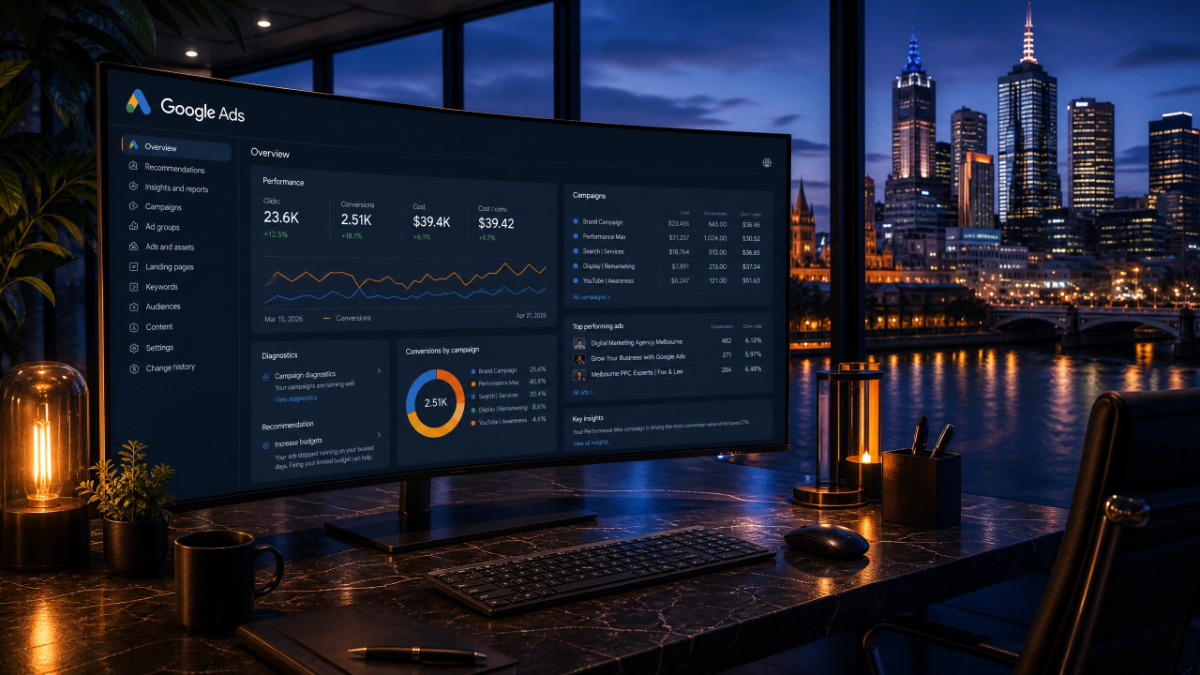
Discover how Fox & Lee compares agency fees, performance benchmarks, and the strategies that drive better Google Ads results in Melbourne.
Search engine optimisation is changing fast in 2026. Fox & Lee’s complete guide covers everything from Core Web Vitals and keyword strategy to AI Overviews to help businesses rank higher.


© Fox & Lee Holdings Pty Ltd 2026